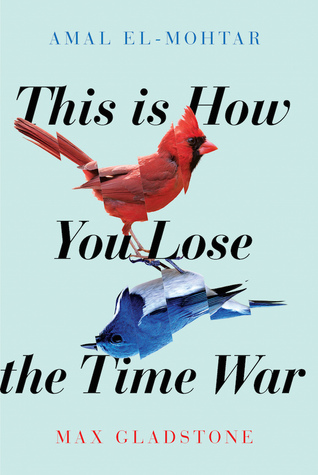
In honor of the Bigolas Dickolas meme moment this book had in 2023, I decided to re-read my favorite book of 2020. This was the 4th or 5th time I’ve read this novella, and it’s still excellent.
Here are some of my other reviews if you’re curious.
- ‘This is How you Lose the Time War’ by Max Gladstone and Amal El-Mohtar
- ‘This is How You Lose the Time War’ by Amal El-Mohtar and Max Gladstone
Goodreads for Jesus and John Wayne
If you’ve been reading my book blog for very long, you’d know that I’m passionate about religion. I’ve read book after book about the saints, the history of christianity, the various religious movements like Catholicism and Orthodoxism, and the history of mysticism in the West.
With my decidedly historical lens, when I turn look at modern American politics… I get baffled. The modern American Evangelical movement really isn’t anything like the historical movements I’m so passionate about. What happened in my homeland that it’s faith has gotten so… weird? I’m not Evangelical, so I read this book as an outsider looking in.
That’s where this book comes in. It starts with the birth of the modern Evangelical movement in the 1930 and 40’s, when the Mainline Fundamentalists and Mainline Liberals clashed with one another and ultimately broke apart on the topic of militarism in the World Wars. From there it weaves a through line in the evolution of the Evangelical movement until we get to today when Duck Dynasty and Donald Trump are cultural touchstones for Evangelism. And the through line the author lays down actually makes sense.
I think this book was written backwards. This book was written more or less explicitly to explain ‘Why do Evangelical Christians vote for Donald Trump, a man who does not live out the Word of God?’ I feel as though the author should have been more clear in her thesis earlier on. At first I was having difficulty putting together the pieces of her jigsaw puzzle, only to have them all fall into place near the end of the book when the topic of Trump came up. By the end of the book I understood that the author was laying the seeds of various topics in their historical context to explain the transformation of a spiritual faith into a cultural movement where the spirituality plays second fiddle to politics.
This book makes me sad in a way no book has ever made me sad. This book is a secular lens upon the death of a religion, and the birth of a warrior cult. I think I need to do more research before I come to any conclusions, however.
If I were to critique this, I would say this was written from an outsider’s perspective looking in, and it’s not very charitable and probably a bit reductionist. I think this book is accurate, but I think that due to it’s outsider’s perspective it might be missing some of the nuance. I’m also an outsider, so I don’t know what that nuance would be.

 John Mendez- Book Reviews and More