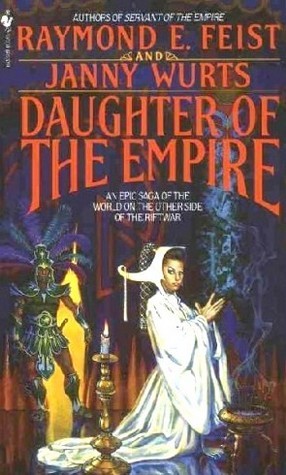
Spoilers Below. I’m writing this review in good faith, as one author reviewing another’s book, trying to balance positives with negatives.
I’m reading this as a part of the Library of Allenxandria bootube readalong. I’ve read and reviewed this book before. I still stand by my old review, so I’m reposting it here with some modifications for my thoughts on this re-read.
CHARACTERS:
If you want to read this novel, read it because of Mara. She is not a traditional action hero. No, she’s a leader of men who doesn’t get her hands dirty. She’s a politician, she’s a mother, she’s a housekeeper. She’s a traditionally feminine woman, who uses her brains and not her brawn. She’s not a rebel against the unjust patriarchy which keeps Tsuranuanni women oppressed; she takes advantages of her patriarchal society’s misconceptions of women and uses those misconceptions to manipulate and control the patriarchy. That’s what makes her special.
But for as fascinating a character Mara is, everyone else… isn’t. Mara’s the only one who has any depth. Credit where due, the other major characters have distinct personalities: Nakoia is a grouchy old man, Liu Ban (I think that’s his name? I listened to the audiobook) was a lovable rogue. However, none of them were more than stereotypes, never getting a character arc.
Overall, I give the story’s Characterization a rating of: (B)
PACING AND STRUCTURE
The story’s plot was good, and at times great, but it suffered from having an episodic structure. Basically, the story consisted of the protagonist solving one problem after another. There was never a through-line connecting all of the small episodes together in a linear fashion. The tension suffered because there was no build up to a looming threat.
- For example, in Episode 2 she recruited some Grey Warriors to her cause. At the book’s climax, those Grey Warriors never became relevant to her victory. This seemed like a dropped narrative thread.
- In Episode 4, she recruits bug people to her cause. The bug people are barely seen again in the book after that chapter. That’s a dropped thread if I’ve ever seen one.
- In Episode 6 she turned down a suitor, and she made an enemy of him. At the climax, him being her enemy should have come back to haunt her. Again, a dropped narrative thread.
The book’s structure was basically whack-a-mole: Mara faces a problem, and she hits it. Another problem appears, and she hits that. Again and again, problems pop up and she beats them. There was no build up of tension caused by a problem she was too weak to defeat yet, forcing her to buy time or hold the problems at bay as she cultivated her allies.
Overall, I give the story’s Pacing and Structure: (D) This is a passing grade, but a bad grade.
PLOT
I liked this book’s plot. After her father’s death Mara must secure her throne, rebuild her army, secure new allies, get rich, give birth to an heir, and finally get revenge on her father’s killers- all while being careful not to step out of the bounds of traditional femininity. Basically, she has a similar plot to Circe Lannister, if Circe wasn’t evil. I liked how Mara at times came off as a little too ruthless- it made her compelling.
The plot had some clunky bits. Mara needed more try-fail cycles. By this I mean that Mara suffered from the problem of succeeding too many times. It seems time and again EVERYTHING goes her way. Time and again, she risks everything in a million-to-one gamble, and it always pays off. I wanted her to fail in the occasional million-to-one gamble, just to show she’s not superhuman, and she has to learn restraint.
One thing I did like in this read-through is the Buntokapi plotline. It was slow and drawn out. Without getting into details, Mara had to trick Buntokapi. I liked that the narrative didn’t have her instantly trick Buntokapi, but instead took several scenes to do it, slowly unspooling a fishingline and baiting the lure, waiting for him to bite. When he finally does, it felt really great. Nothing else in the story felt as well written as that storyline.
Overall, I give the story’s Plot: (B)
SETTING
My impressions from my first readthrough three years ago:
I loved the setting. Tsuranuanni society is honor obsessed. And I mean OBSESSED. I loved it. Being honorable is woven into every aspect of their society, so much so that even the spies and thieves are honorable. People who are caught acting dishonorably must either run for their lives, or commit ritual suicide. Frankly, it’s so obsessed with honor as to be implausible- you have to suspend your disbelief.
This book’s society was fascinating as a result. The book was based on an Up-to-Eleven version of cliched feudal Asia, but in so many ways the setting’s uniqueness took it out of being cliched. Mara’s cunning use of her society’s obsession with honor is what allowed her to thrive and control her circumstances.
There were some weird quirks about the setting which didn’t seem to quite work (the whole concept of Grey Warriors just doesn’t hold up, and the bug-people were weird).
I give the Setting: (A)
My impressions from my second readthrough:
I didn’t really like the setting. On this read-through, the setting’s honor struck me as being overplayed and so implausible as to be unbelievable. The fact that even the spies and thieves were honorable just didn’t work for me. I wanted to see the underbelly of this society. If this were the real world, there would be some counterculture that rejects the honor system. Where is it?
To be clear, I still like how honorable and ritualistic this society is. But I want to see the actually breathing society beneath the pomp and ritual. The fact that it was so homogenously honorable and ritualistic stretched my suspension of disbelief past the breaking point at moments.
I give the Setting: (B-)
PROSE
Occasionally the prose had moments of being drop-dead gorgeous. Overall, the prose was more functional. On the stained glass/window pane glass spectrum of prose beauty (stained glass= beautiful for beauty’s sake; windowpane= clear and unobtrusive prose), I’d place it slightly on the stained glass end of the spectrum.
If I were to hand this a complaint, I say that too often the narrative told when it should have shown. This is a high-context society, meaning that to live in this culture you have to learn a lot of background information. Whenever this background information was needed, the narrative would stop for a minute to worldbuild and exposit to the reader. This pausing of the narrative for the sake of infodumping got repetitive and boring.
I give the Prose: (C)
I enjoyed this book, both the first time I read it and the second. However, I think I enjoyed it somewhat less on the second read-through. Check it out if you want a non-traditional female protagonist who’s willing to use her brains and not brawn to out-scheme her opponents in a highly patriarchal world.

 John Mendez- Book Reviews and More