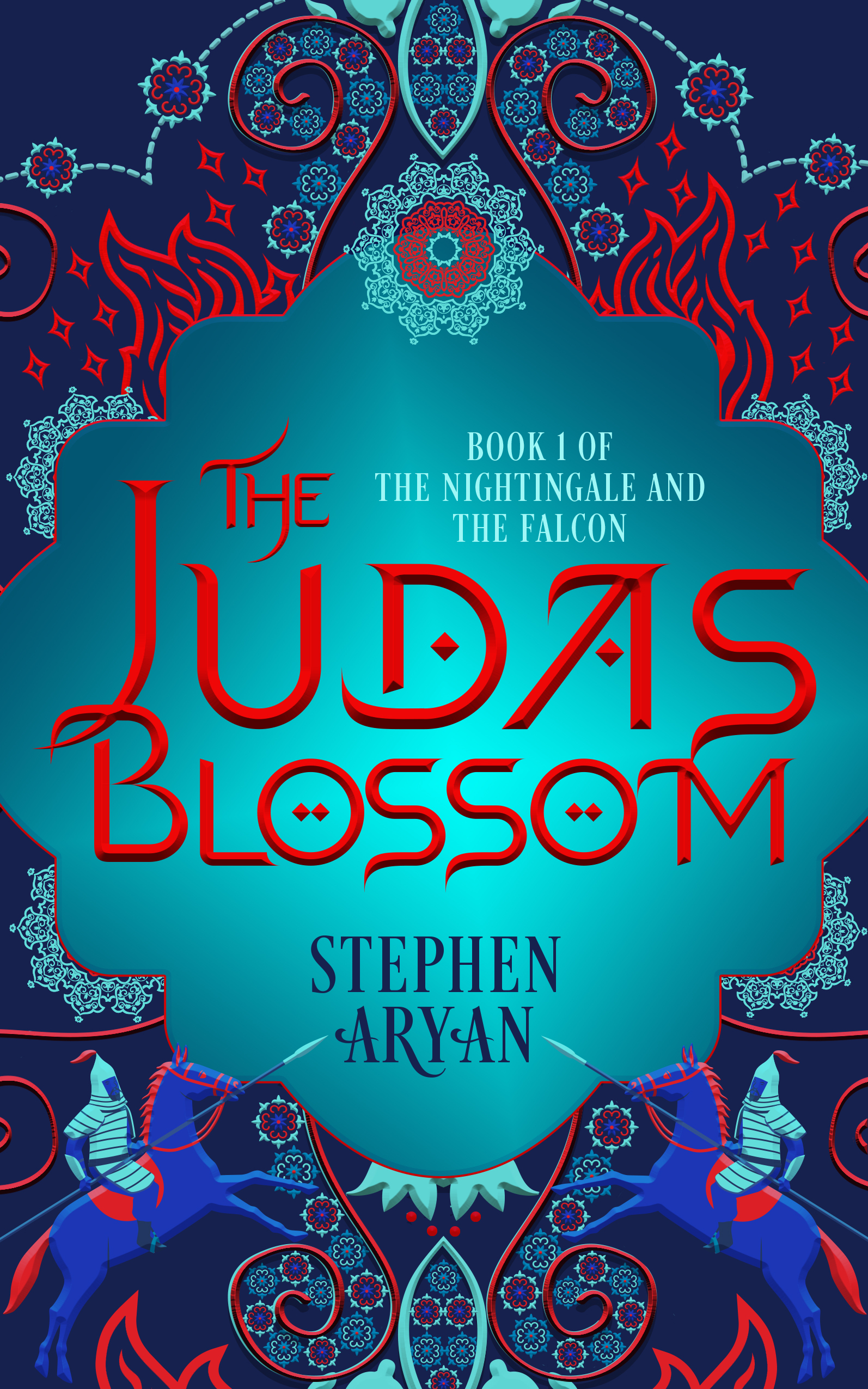
The Mongols came, and killed everyone. The legendary assassins fell before their blades. Persia was destroyed, and taken by the Ilkhanate. Soon Baghdad will fall, and all of Islam will tremble.
In the wake of this conquest, the embers of rebellion still burn. But whenever someone attempts rebellion, the Mongols clamp down and kill indiscriminately, punishing both the innocent and guilty. If the Ilkhanate will be destroyed, it must be done with the brain, not the sword.
I really enjoyed this book. Let’s get this review started.
What is the target audience? What Genres? What Major tropes?
- Alternative History Fantasy, retelling the story of the fall of the Persian Abbassid Empire to the Mongols.
- 18+. There’s violence and death, and sexual content. Someone younger can read it, with adult supervision.
- Military Fantasy. This is the story of the Mongol Conquest of Persia, with a bit of magic thrown in.
- Political fantasy. There are schemers aplenty in this book.
- Rebellion Fantasy. This book shows the formation of a rebellion against an evil empire.
My Broad Thoughts
4 stars. I really wanted to give this 5 stars, but three things got in the way of it.
First I listened to the audiobook version. I thought that the narrator did a great job acting out the narration. She was a great actor, bringing virve and character to the written words. However the actual sound quality of the mp3 file was below the standard one should expect. The quality was good enough to listen to/be readable, however it still wasn’t perfect.
Second, the book was a lot of building up to a climax, and then ended with a cliffhanger without that climax happening.
Third, it needed more horses.
Again, I want to give this 5 stars. This reminded me of one of my favorite series, ‘The Eternal Sky Trilogy’ by Elizabeth Bear. I’m a big fan of Central Asian/Nomad/Mongol fiction, and it’s so rare to read in the genre. The Characterization was Great, the Plot was fun and well paced. 4 stars because I couldn’t overlook the flaws.
For reference, I give 5 stars to only the top 15% of books I read. This is still a very good book. Get a paper copy or an ebook. You’ll love your time with this book.
Plot
I loved the plot of this novel!… until the very end of this book. Let me explain.
This book retells the tale of the subjugation of the Abbasid Persian Empire by the Mongols in 1260. It covers everything from the fall of the Assassin order to the Sack of Baghdad, and the subjugation of Aleppo and Damascus. It has light magical elements in one of the characters; otherwise the story is very magic free.
This book is a very political book. Most of the three main characters hate the Mongol Empire and are working to undermine it. However the Mongols are so brutal they cant be caught because if they are they’ll not only be executed, but lots of innocent people will also be executed in reprisal by the Mongols. So the characters must scheme and plot in the shadows, doing everything in their power to not be caught. To use a metaphor, they’re trying to kill a bear by stinging it to death with bee stings.
SPOILERS! As an example, Kaivon goes under cover as a Persian who switches sides to serve the Mongols. As a Mongol vassal, he undermines the empire by syphoning away money and from the Khans and to the rebels, and then blaming other Khans for the money which disappears. Or look at Kokochin; she starts as a Mongol Princess, but to avenge her family killed by Kublai Khan, she turns traitor and starts assassinating minor Mongol magistrates.
Together, most of the protagonists form a network opposing the Ilkhanate. You can see a budding rebellion building up between the chapters, forming in a believable and grassroots sort of way. When we occasionally get the perspective of a Mongol loyalist, it was fascinating to read how they were frustrated by the schemes of the protagonists.
THAT SAID, I feel like this book didn’t have a satisfying climax. It had a cliffhanger, ending on the note of “This book is part one of a series. I hope you come back for book two!” There was no grand climactic battle at the end of this, there was no buildup and then payoff; the protagonists all had massive twists at the very end and then the book closed. This is not a bad way to finish a book, I just don’t like cliffhangers.
Characters
I’ll start with my favorite part of this book: the protagonists.
Temujin is the youngest son of Hulagu Khan. He starts the book a bit of a wet blanket. He’s fat, young, and naive. Yet Hulagu hates him for weakness, so Temujin is thrown by his father into the middle of war to toughen him up (and maybe kill him. Hulagu doesn’t care if he dies). When Temujin not only does toughen up but also gains magic, he becomes Hulagu’s new favorite. At first Temujin wants his father’s approval, but upon gaining it he realizes his father only loves him so long as he is useful, and even now doesn’t love him as a person. Temujin ends up rebelling against his despotic father, burning the House of Wisdom and sets off on a mystical journey.
I had a touch-and-go relationship with this guy. On one hand, I thought he had BY FAR the best character arc in the book. On the other hand, I don’t get his starting point. He’s a Mongol Prince; why does he start the book such a wet blanket? Just growing up in the culture he grew up in, he should be brutal and harsh; he shouldn’t need to be toughened up. It’s never explained why Temujin is so nonviolent in the first place. Did I miss something when I read it? This one plothole was enough to undermine Temujin’s entire character arc in my eyes.
Kokochi and Kaivon are the other to primary protagonists. I liked them both. Kokochin is a princess, the sole survivor of her tribe, killed by Kublai. He sole goal is revenge against the Mongol Empire by destroying it from within. Kaivon is a Persian General, who decided to go under cover as a servant of the Mongol Empire to destroy it from within. Neither had a super-dramatic character arc. Nothing bad, to be sure, but nothing distinct as yet. They need the rest of the series to flesh them out.
The book had a number of other POVs, some loyal to the Empire and some antagonistic. Hulagu himself didn’t have too many chapters, but when he did they were some of my favorites.
Worldbuilding/Setting
On one hand I want to rave about the setting. We have the Order of Assassins! We have persia! We have the Mongol Empire! They discuss the various religions of the steppe/Middle East, from Christianity to Judaism and Buddhism and beyond.
The day-to-day governance of the Mongol Empire was run by it’s princesses and Empresses, and not it’s Khans. Simply put, the boys were all busy taking over the world the girls would actually do the heavy lifting of making boring bureucratic decisions on how to run their conquests. When they’d conquer somewhere new, the Khans leave one of their daughters there to run things while they were off being bloodthirsty conquerers. This was captured in this story very well, with Kokochin and the women who surrounded her
The Mongols were a very pious people. They respected all gods, and all religions. They treated priests from even religions they didn’t agree with with reverence. Yes, the Mongols would regularly sack and destroy temples. But when they weren’t doing that, they were very religiously tolerant. This book does a good job in some way demonstrating that; the Golden Horde are shown to be Muslims; Hulagu’s wife is Nestorian Christian; the Pope plays an obscure role off to the side. Buddhist meditation is repeatedly mentioned. I really like this true-to-life diversity.
On the other hand, the author missed the devil for the details. I’m gonna start quibbling here. None of these complaints are dealbreakers; I gave this 4 stars, which is in the top 35% of books I read. However they did detract from my suspension of disbelief.
The Mongols were horse lords. If you look at pretty much any piece of Mongol Empire art, a lot of it will feature horses. The Mongol Empire was forged by horse archers, with each soldier having three horses apiece to maximize speed. The Mongol Empire had a FANTASTIC system of mounts and remounts, so messages could travel across Eurasia in a single month, instead of 4+ months without remounts. The Mongols played horse polo, using a goat carcass as a ball. They drank mare’s milk alcohol… aka, horse milk.
IRL, Mongols = horses.
This book did not have horses.
Okay, that’s not quite true. If you read the book, you understand that horses are going on somewhere in the background. HOWEVER, if you read a book about the French Revolution, you expect a guillotine to show up. If you read a book about the American West, you expect a gunfight at high noon. If you read about the Mongol Empire, you expect horses to be prominent. Reading this, I feel that the author ‘missed the forest for the trees.’
This book does a LOT very well. It does great work discussing the factions and events which were alive and well back then, from the Pope as a political figure, to the House of Wisdom and the Sack of Baghdad, to Nestorian Christianity; things rarely discussed today. But it discussed them from a bird’s eye perspective. The book rarely gets into the details of culture or food or textile patterns… or horses.
Structure and Pacing
I feel like the book was well paced. I don’t think it had a slow start; indeed the book begins with the Mongol Sack of Alamut, the bastion of the Order of Assassins. It was instantly compelling reading.
Structurally, let’s take a look at Temujin’s plot arc. I think it used the 5 act format. Here are the acts as I see them.
- Life as a Taxman; failure as a taxman
- Drafted into service in the Sack of Baghdad
- The House of wisdom, the Eternal Flame, and earning his father’s approval
- The siege of Aleppo and Damascus, and meeting the heterochroma woman
- Betraying his father
Lessons learned
- This book does a really, good job showing the social and political makeup of the Ilkhanate at the time of it’s formation. From a bird’s eye view, this is a masterful display of what Historical Fantasy should be. Research research research.
- At the same time, it missed talking about the setting in much depth. The Mongolians were superb horsemen, and yet horses are not much discussed here. From a bird’s eye view, this is a great story, but up close it’s lacking in detail. Research research research.

 John Mendez- Book Reviews and More