NOTE: I originally read this book in early November 2023. I decided to hold off on publishing this, hoping for some clarification about what happened in 2023’s Hugo nomination process.
The first half of this critique is about this book, and the second half my reflections on the present state of the Hugo awards, including a (very brief) discussion about the Babel situation.
I recently enjoyed reading ‘The Spear Cuts Through Water.’ I personally thought it was of award quality, and include it in my personal top 5 favorite-books-of-all-time list. However, it wasn’t even nominated for the Hugo, or any of the other major awards (it was nominated for the Le Guin, so that’s something). I didn’t understand why it was snubbed; in prior years ‘Spear Cuts Through Water’ would be the exact the sort of book to be nominated.
The Hugo is the SFF award with the longest legacy. ‘Dune’ and ‘Jonathan Strange and Mr. Norrell and ‘The Left Hand of Darkness’ are Hugo winners. I would personally include ‘The Spear Cuts Through Water’ in that same club.
While reading a few Reddit threads on the topic of nominations, ‘An Informal history’ came up as suggested reading. (Thanks to u/KristaDBall in this thread and u/Goobergunch in this thread. Together, they put me over the edge of checking this book out from my library).
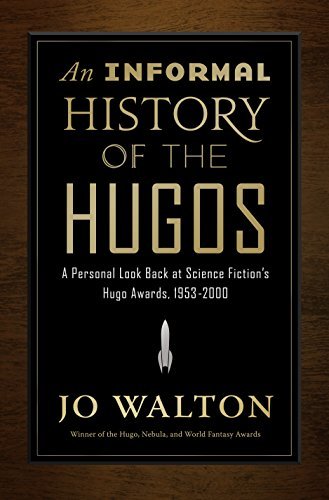
‘An Informal History’ sets out to contextualize the entire slate of the Hugos on a year-by-year level. It lists all finalists for all the Hugo awards (Best Novel, Novella, short story, editor, fanzine… etc. Including the Campbell Award for Best New Author). It goes from the 1950’s to the year 2000. The author included alternate possible nominees, including the finalists for the Nebula, World Fantasy Award, Locus, Mythopoeic, Prometheus and (at least once) a Libertarian Fantasy Prize. Additionally, the author included noteworthy books which were not nominated for any prize. All together, it does an excellent job discussing the slate and possible alternative picks.
The contents of this book were originally published online in 2011 as a sequence of blog posts on tor.com. On that website, people could comment. The author included many of those comments in the actual text, and it helped flesh out the commentary greatly. Most notably, Gardner Dozois provided a TON of commentary about the novella, novellette and short story sections for virtually every year. The comment section also sometime included comments from the authors discussed in the actual slate. I found it highly valuable.
This book provided context for each individual year. It broke down the details of every nominee, discussed the author’s opinion of every finalist, discussed general opinion of the finalists, and how each book aged over time (using the availability in local library/availability in print as metrics for whether it is still culturally relevant decades later).
The biggest flaw of ‘An Informal History’ is that this book needed more cross-year commentary. It did a good job of discussing every year individually, describing whether a particular slate of nominees deserved to be nominated. However the book didn’t do a good job of establishing a narrative between years.
- For example, at one point the author mentioned how Asimov stopped automatically winning the award, and that was a sign that the old stalwarts who used to be the majority of the electorate were replaced with a newer electorate who weren’t as attached to Asimov.
- At another point, the book mentioned how some people accuse Bujold’s fandom of mindlessly voting for her because Bujold had a string of nominations/victories, calling her the Queen of the Hugos. However, the author of this book points out that when Bujold wrote a forgettable book (I think ‘Cetaganda?’), ‘Cetaganda’ wasn’t nominated, disproving this gossip.
That’s the sort of theories and scuttlebutt I wanted more out of this book. This history book looked at the past head-on, but never drew back the curtain to see the sausage being made. I wanted more sausage. I wanted this to discuss more scandals.
- As an example, in every chapter the author points out the gender ratio of the Best Novel Authors. The narrative would point out, ‘Four men and one woman were nominated this year.’ Or ‘Five men were nominated this year, and no women.’ HOWEVER the book never steps out of itself for a chapter to actually discuss the skewed gender ratio.
- Likewise, this book points out that usually only Americans and Brits are nominated, and few non-Anglophone people are nominated. But it never actually discusses this issue.
To me it felt like this history book missed the forest for all the trees. It discussed the health or illness of each tree in question FANTASTICALLY, but never the health/illness of the forest itself.
Overall, I feel that Walton took a very mature view of history. She was less concerned with ‘is this book in particular worthy of winning?’ And more of ‘is this slate of finalist novels representative of the cream of the crop of novels?’ As an example, the author stated she didn’t personally like ‘Neuromancer’ but it was nonetheless a good winner due to how influential it has been in the genre ever since.
Bringing this story back around to today and ‘The Spear Cuts Through Water.’ Books are regularly snubbed by the Hugos. Walton suggested in your average year (for the sample size between the 1950’s and 2000), only about 70% of the nominees are representative of the best quality of the field. When the 30% happens, stuff slips through the cracks.
Finally, I discovered a few new books while reading this. Expect some golden oldies reviews in the months to come.
About the modern awards…
After originally writing this, I debated deleting this bit about the modern awards from my review. As a general rule, I try not to stir the pot. I held off on publishing this review for a few months, hoping for an explanation about what happened with ‘Babel.’ After we got an explanation, I feel safe publishing this.
Before we begin, it’s important to acknowledge that the vast majority of the people involved with the Hugo award process are acting in good faith. People involved try to make the awards an event to remember, to honor people who work hard in the lonely job of art. These are friendly people doing their best, sacrificing their own time and money for this community.
I don’t think the Hugo Best Novel finalist nomination/election process is in a healthy spot in the modern day.
- WTF happened with Kuang’s ‘Babel’ in 2023 not even getting a nomination?
- The Hugos were given out in Chengdu, China in 2023, and Kuang is politically outspoken about Chinese history. The fact ‘Babel’ didn’t get nominated sure looks like meddling.
- I’m on the record for not liking ‘Babel,’ but this reeks. The author deserved it.
- It’s bad that authors feel it’s necessary to recuse nomination for the biggest award in the genre. A healthy awards system shouldn’t regularly have people refuse the award.
- For example: Leckie recused nomination for ‘Raven Tower’ so someone else might get the award. There are many, many other recusals I could point to.
- The Hugos always had blindspots, going back to the 1950’s. Used to be women barely got onto the ballots. The inverse seems to be true these days. Having a gender bias on the level of the 1950’s in the 2020’s is a bad look.
- Some people have pointed to an over-reaction to Hugo Puppygate for the present problems.
- For the record, I think it’s good that woman, queer and BIPOC books are being nominated.
- The same authors are nominated year-after-year.
- This was always true, going back to the bad old days. Heinlein/Asimov would consistently get nominated/win, even with their bad books. Still, it seems to be getting worse.
- Giving the nomination to an established author indirectly hurts an author whose career is only starting, or in a slump.
- On a related note, sequelitis. A lot of sequels make it to the finals these days. On more than one occasion in the last decade, half the ballot have been sequels to books which have previously been nominated.
- I personally find it intimidating when sequels are nominated for ‘Best Novel.’ It’s a LOT to ask for readers to read (and buy! don’t forget buy!) an entire series just to stay up to date.
- And furthermore… why nominate the same series annually? Isn’t propping up a series once enough?
- Various Tor imprints are overperforming in terms of receiving nominees and winners
- This is nothing new. In the past ‘Asimov’s Science Fiction’ used to run the table.
- Self-pub books are rapidly meeting- and exceeding- the high bar of quality the industry sets. And yet, the Hugos only nominate books which are industry published.
- It’s not a good look that the Hugos exist primarily to market corporation books at the expense of indie books. I thought y’all hated capitalism, ya hypocrites.
I’m optimistic about the future of this particular award, precisely because this most recent clusterf*** is so huge they have to do something instead of just coasting along as usual. Hopefully Worldcon sorts out whatever happened surrounding Chengdu this year, and use the momentum to solve some of the other issues which have gone unaddressed for the last decade or two.

 John Mendez- Book Reviews and More