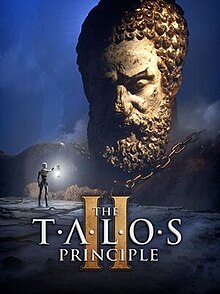
Here is my review for the first game.
The first game was one of my favorites of all time. This game is an improvement in gameplay by leaps and bounds. This game was only 75% as good story wise as the first game; it’s still a wonderful story, but something about the reduced scope of the first game was more compelling for me. THAT SAID, Talos Principle 2 had an excellent story, whose focus on philosophy made me guess and rethink my choices time and again.
We organic humans went extinct when a virus came around and killed us all. Before we died, a group of engineers and scientists set up a server system which will create an AI; there is no hope for organic human life to continue, so we threw light into the future for inorganic life. This is the story of game 1.
A thousand years passed, and now a city of robots exists in the ruins of organic humankind. The city has reached a turning point: do they philosophically follow in the footsteps of vanished humanity, and strive for the stars? Or do they remain humble and accept a limited existence, and not potentially make the mistakes which cause humanity to go extinct?
This game is deeply philosophical. It argues for two viewpoints: in favor of unfettered human reproduction/creativity/spreading life to the stars; and in favor of remaining humble on Earth, letting life spontaneously occur out in the stars, and becoming one with nature. Both viewpoints are persuasive.
This game’s gameplay is all about laser puzzles, just like the first game. I felt that the puzzles in this game were better than in the first; in short, this game has more varieties of puzzle to play around with. The first game only had re-directing prisms, fans, blocks, and obstacles; the second game has all of that as well as nine other new mechanisms like teleporters and rotating floor segments. The first game relied on intricate and complex sequence of decisions to solve a single puzzle; you could solve all the puzzles with brute effort and little thinking. This game relies more on creativity and adapting to new tools, to solve simpler and more creative problems.
Game 2 is an improvement over game 1. I suggest you play both. If you have a computer which can handle Unreal Engine 5, play game 2 first, then go back to game 1. If you don’t have such a powerful computer, play game 1 first.
Finally, bugs. I only encountered 1 serious bug when I was stress-testing the game and pushing it beyond it’s limits. This compares to game 1, which I experienced crashes playing. Game 2 never crashed, nor suffered really. I was really impressed, usually these days games are super buggy.

 John Mendez- Book Reviews and More