Cradle book 4. My favorite so far. I think the author’s prose has improved, as well as pacing, and a sense of a strong plot. With the introduction of dreadgods as main antagonists, the series finally feels like it’s starting. The dreadgods don’t come out of nowhere, they were mentioned in earlier books, and in Suriel’s segments. I like that it feels like the series is expanding outward, exploring new facets of the setting’s lore.
I also like how Lindon’s arm was cut off. I’ve heard that it’s a danger in LitRPG for a protagonist to never suffer a setback. This setback gives Lindon’s overall quest a sense of ‘ups and downs.’ Lindon has overall come very far, but given that he a)lost a fight against Jai, losing his arm and b)we see that Lindon must defeat the uber-powerful dreadgods really shows just how far Lindon still has to go.
I’m trying to put my finger on exactly why I’m enjoying this series so much. I think it’s simply because I’ve been with these characters for so long. I don’t think it’s an accident that in Fantasy many of the most beloved series are also the longest. Being with characters/a setting for such a long time tends to build fondness for it. After 4 books, I’m fond of Yerin and Lindon.
This was a quick re-read for me. I’m re-reading this series/finishing the books I’ve not read.
I really enjoyed this book. I like how it expands the setting (travelling through the Gobi desert; feral dragons and their society; the Ottoman Empire; Napoleon’s French and Prussian War). So many mini-stories was fun, but don’t make for a very satisfying story overall. This felt more like an anthology of stories overall, rather than a cohesive unit.
The Two Towers and Return of the King
Re-read. Was excellent. Full series review already out.
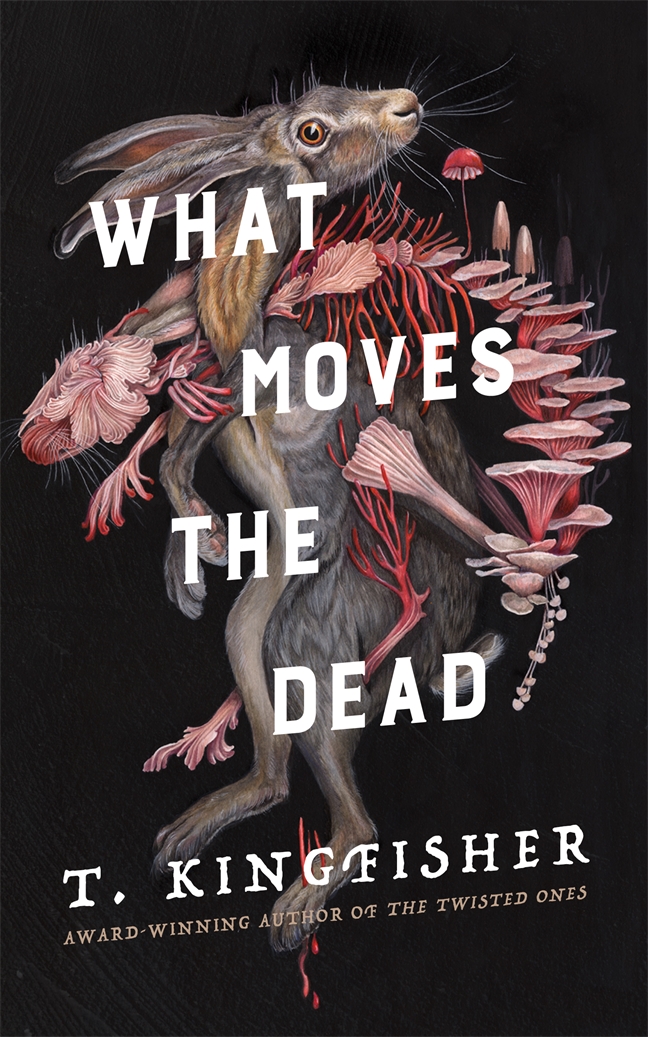
This is a trans/nonbinary retelling of Poe’s House of Usher. I’ve not read the original, nor seen any adaptation, so I had no nostalgia.
I enjoyed this work of gothic horror. Kingfisher has good prose. While I feel like this book had a slow start, it ramped up into enjoyability. I understand why this is popular: there is a good sense of tension, character, place and historicity. I enjoyed the eerieness, its mild grossness, but I found it was never scary.
But it wasn’t perfect.
There was no overarching theme. For example, horror is often used to critique social ills: vampires for the aristocracy or zombies for mindless capitalism, as examples. I can’t figure out what sort of social critique the fungus represents, or how the protagonist’s trans/nonbinary nature interacts with the theme. I think the author set out to write a fun bit of pulp, without social critique. It’s fine that this lacks critique, but I can’t really get excited for it.
This is my third Kingfisher book, and while I acknowledge she is a skillful author, arguably one of the best working authors in the genre, I just don’t know if she’s for me. This book seemed oddly twee at moments (can horror be twee? because this horror novel feels twee). Cozy/twee is not my vibe, and it’s something Kingfisher seems to rely upon. I think there is a fundamental clash between the author’s cozy/twee authorial voice combined with the horror elements. I’ll keep reading her books occasionally, but Kingfisher will prob never be a favorite.
Ghostwater and Underlord
Cradle books 5 & 6. If I’m looking at this series objectively, it’s just a series of fight scenes/characters sneaking around to avoid fighting people more powerful then them/leveling up so you can fight stronger enemies. Summarizing it that way, it makes it sound bad. It’s not bad though. Sometimes you’re just in the mood for some serialized adventure fiction, and this scratches that itch.
I’m having fun. If I were to rank them right now:
- Underlord
- Skysworn
- Ghostwater
- Blackfire
- Unsouled
- Soulsmith
I like Underlord, Ghostwater and Skysworn about the same. Ghostwater has a better contained plot and setting; Underlord a more cohesive narrative, where I enjoyed hearing from both hero and villain perspectives; Skysworn had higher stakes which I enjoyed more.

 John Mendez- Book Reviews and More