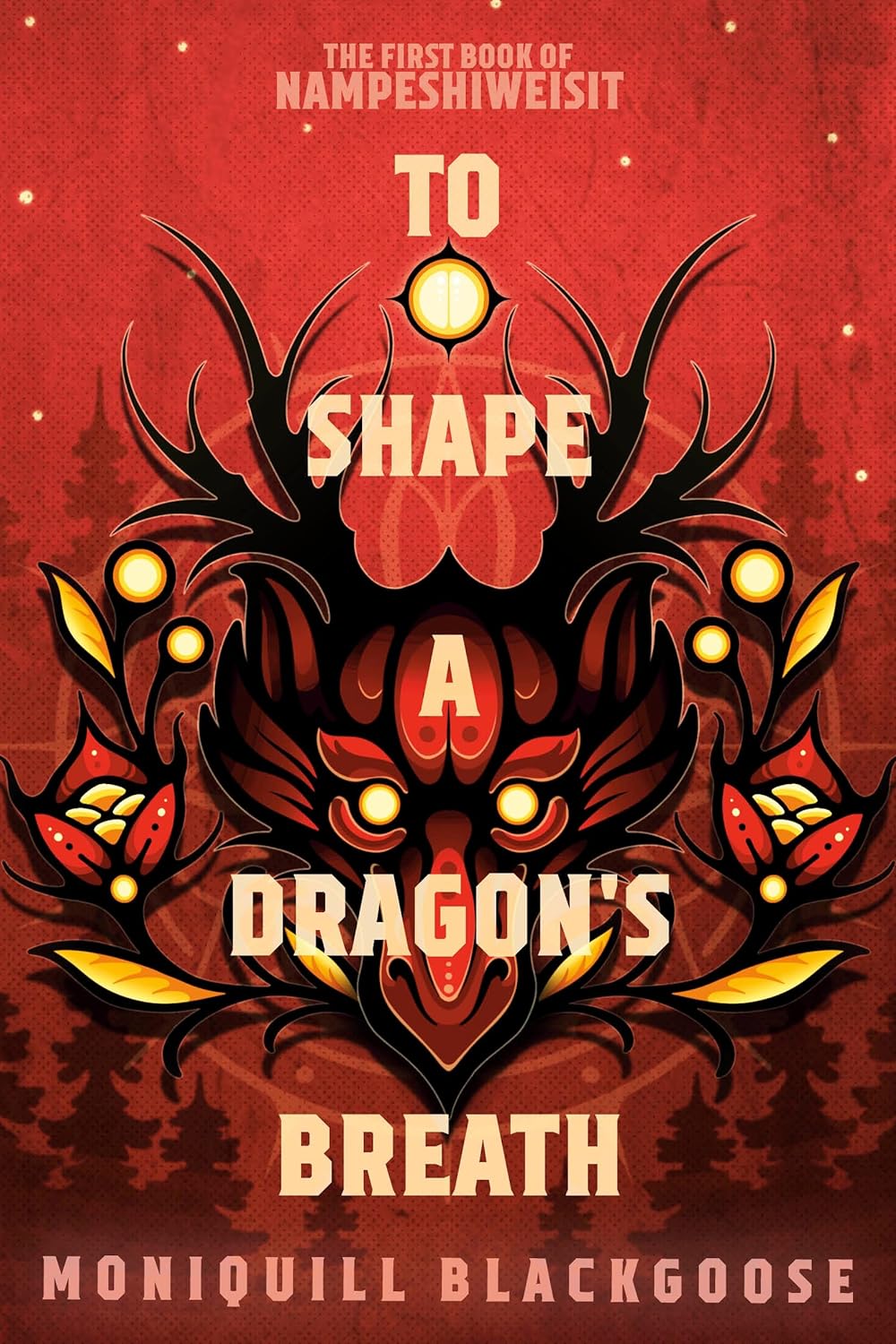
I’m a fan of the genre of dragonrider fantasy, so I decided to check this out. This is a secondary world fantasy, set in a technological era similar to the mid-1800’s (whaling and coal power is strongly featured; there are guns; the women wear corsets). The protagonist is Native American-inspired. She is the first dragonrider to come from her culture since her people’s defeat and colonization by a bunch of invaders whose culture is a mixture of Viking-era Norse and British High Empire. She and her dragon are forced to go to a snooty dragonrider academy with the Norse people, thriving in an environment which seems out to defeat her.
I’d compare it to Temeraire in terms of British dragonriding, mixed with a mid of academia, mixed with underdog woman in a patriarchal society, mixed with an anti-colonial parable. I enjoyed the novel most when it focused on the protagonist’s indigenous culture. I appreciated that the author tried to give the invaders a Norse spin; for example, instead of slaves, the people become thralls instead; instead of a king or governor, there’s a jarl. I wish the author leaned into that Norse-ness even more, instead of making them culturally British. (By ‘culturally British,’ I mean that the women wore corsets and soldiers wore tassels. The overall culture possessed a strong upstairs/downstairs vibe.) The novel also had a steampunk element, with machinery and 1800’s technology.
I think this is a good-to-great novel, but didn’t like it myself. This book had cozy vibes, and I do not like cozy. So, I respect this novel and author, and acknowledge the problem is me. I look forward to reading more by this author in the future.
Another day, another Cradle book. Spoilers!
I have mixed feelings about this novel. On one hand, this had one of the strongest, self-contained plotlines in the series. On the other hand, it was a tournament arc, and tournament arcs are by nature a bit low-stakes. I know that the winner of the tournament will go on to take over the Blackflame Empire, meaning the fate of everyone is on the line. But in actual practice, it’s a bit boring. This novel had too many fight scenes, and none of them had consequences. Any character who died in a fight scene automatically came back to life because it was a tournament. As a result, important characters were constantly dying, and I just didn’t care.
I will say that the fights in this book were awesome. In particular I liked Yerin vs Lindon, Lindon vs the last Blackflame Prince and Lindon vs the Akura Clan Underlords. Yerin vs Lindon in particular is the best the series has so far.
I am enjoying the slow burn romance between Yerin and Lindon. It’s taken 7 books and they’re not even at first base yet, but you can really tell how much they care for one another. I am largely indifferent to romance in the novels I read, but this has been so slow that it’s working for me. This is progression fantasy, so I appreciate that the author is stepping a bit out of the genre wheelhouse to include an alternate form of character progression.
One final note. I’m struggled with this book’s editing. Some of Dross’s dialog boxes are missing. Not a big deal, and doesn’t happen in later novels.
The direct sequel of Uncrowned, beginning the exact moment Uncrowned ends. This novel finishes the Uncrowned tournament arc. Uncrowned very much so feels like a Part 1 and this is Part 2.
I enjoyed this one more than Uncrowned; this one felt like it had stakes. We finally had battles with consequences. There was a lot less of that tournament resurrection nonsense.
I think this could have been shorter. It’s a bit bloated with too many fight scenes. I feel like this novel and Uncrowned could have been a single novel. Put together, they’re good.
I personally feel that this is the best book in the series, at least so far. With the dreadgods converging on the Sacred Valley, Lindon must go home and help save his family. I did not like the first two novels in this feel; personally feel this novel redeems the first two novels in this series.
I bounced off books 1&2, in part because literally all the non-Lindon/Yerin characters were various shades of nasty; it was like reading a massive series where all the side characters are the Dursleys or Umbridge. In this novel, we are reintroduced to all those nasty characters… and they’re still nasty. The heroes must save Sacred Valley, but Sacred Valley is such a cesspool of ordinary nastiness that everyone refuses to be saved. I was not expecting this; I was expecting that when we returned, that the people of Sacred Valley would have had an off-screen personality transplant and become nice people (or at least not actively hostile). Having the people of Sacred Valley still be nasty both subverted my expectations while at the same time was completely obvious. You so rarely see examples of ‘the bus came back’ trope done so well.
I loved that the heroes had to save Sacred Valley, even as the Valley were kicking and screaming and refusing to be saved. When the people of the Valley repeatedly tried to kill them, I was so frustrated I wouldn’t have blamed the heroes if they left the Valley to die.
And we have stakes! I enjoy there is the possibility of failure, after all that tournament resurrection bullshit.
Finally, I liked how the heroes cooperated to distract and dissuade the dreadgod at the end of the story. I found it a very compelling fight scene.
I enjoyed the high-tension of Reaper. Travelling through the labyrinth to reach the dreadgod at it’s core was fun. I enjoyed the battle against Reigan Shen; I think that was my favorite battle in the series so far.
I enjoyed Dreadgod less. I like the Silent King as an antagonist, but I feel he was underused. As a monster with mind-control power, this novel really had the potential for a lot of ‘Manchurian Candidate’ shenanigans. That would have been a compelling read. Unfortunately, the limelight in Dreadgod was split between the Silent King and the Wandering Titan. We already fought the Wandering Titan in ‘Bloodline,’ I think he shouldn’t have been featured at all. I wish the novel doubled-down on the Silent King, with the entire novel being devoted to rooting out traitors from their midst.
I really liked the second half of ‘Dreadgod.’ If I were to judge the second half in a vacuum, I would give it 5 stars. I feel like the first half of this novel was very slow paced with relatively little happening. I feel like there could have been some trimming in the first half.
Hot damn, what an adventure this has been. I’ll admit this final book has flaws; it’s plot is basically ‘fight scenes and training montages with zero characterization.’ However it pays off pretty much every storybeat left untied in the series thus-far. 5 stars for satisfaction, even if objectively it’s probably closer to 3 to 3.5 stars.
Additionally, Threshold is a fun little coda added to the end of the series. Not necessary to read, but I enjoyed it.
Series ranking:
- Bloodline 5 stars
- Waybound 5 stars
- Reaper 4.5 stars
- Uncrowned+Wintersteel (I’m grouping these two, because they are together a whole storyarc.) 4 stars
- Dreadgod 3.5
- Ghostwater 3.5 stars
- Threshold 3.5
- This is an anthology of Cradle stories, before, during and after the events of the series.
- Underlord 3 stars
- Blackflame 3 stars
- Skysworn 3 stars
- Unsouled 2.5 stars
- Soulsmith 2.5 stars
Note that I default to giving good books 3 stars. I only give 15% of books 5 stars. 2 star books I define as fun, but not for me.
Sequel to ‘The Bladed Faith,’ which I read a year or two ago. I enjoyed the first book, and I found book 2 to be a step up in quality. This is a somewhat dark fantasy adventure, about an island nation which has been conquered by a supernatural theocracy. The native gods/religion are fighting to survive against colonizers intent on wiping them out.
I liked how the author explored the nuance involved in colonization and exploitation. This is the story about an island which has been repeatedly invaded over the years; at the beginning of the series, a theocratic nation invades and destroys the monarchy which the last wave of invaders set up. The philosophical underpinning of the series is the protagonists grappling with being held under the boot of the oppressors, when they themselves were the oppressors not so long ago. The characters must realize that they themselves don’t have clean hands, and try to become better.
A lot of books these days which have colonization as a theme; most of them just say ‘colonization=bad…’ which is, you know, very on the nose. I enjoyed that Dalglish didn’t make this series seem like a lecture, or preachy. I liked that the author focused on the ambiguity, and made it clear that some mistakes can’t be forgiven. I define a ‘preachy’ book as a novel where the theme of the story felt like it was made to serve the plot, as opposed to the plot being made to serve the theme. You can’t 1:1 map the story directly onto modern day politics.
Even so, this is at it’s heart a fun adventure story. Don’t go into this expecting to read a sociological essay. The adventure is the point.
As a con, I found some of the language the author used to be out-of-place. For example, a character at one point felt ‘tell me how you really feel;’ this is a modern anachronism in a story with gods and swords and without internet culture. I’m inclined to forgive, because it only occurred a few times throughout the book.
I very much so enjoyed this novel overall. This will probably be in the top 10 books I read this year, and this series in the top 200 books I’ve ever read. I’ll read the final book one of these days/years.

 John Mendez- Book Reviews and More