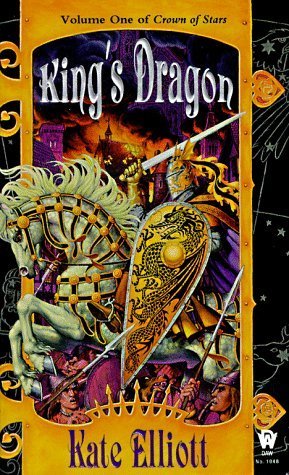
King’s Dragon is book 1 in Kate Elliott’s ‘Crown of Stars’ Heptology. It is an Epic Fantasy series in the vein of ‘Game of Thrones’ or ‘Memory, Sorrow, Thorn,’ in terms of being a novel about a story about scheming political houses in a Medieval Europe-inspired setting. I chose to read it for two reasons: first, I heard good things about it’s worldbuilding being inspired by actual Medieval Europe, and not the tropey pastiche which is so common; second, because I want to read more Epic Fantasy written by women.
The story takes place in the twin-kingdoms of Varre and Wendar. Varre and Wendar were recently joined together by the actions of King Arnulf. After Arnulf’s death, his son Henry and daughter Sabella fought for the throne. Henry was crowned King, but Sabella never gave up her monarchal aspirations. One of the two main plotlines in this novel is Sabella’s civil war against Henry, trying to claim the throne she feels was unlawfully stripped from her.
In the background of this, orc-like raiders are attacking Wendar. King Henry’s most elite soldiers- the Dragons- are sent into the breach, trying to stop these raiders. As a result, there are two wars being fought in Wendar, so the forces of ‘good’ are stretched quite thin.
Reducing the scope of the novel from the broad and political, down to the close and personal, we introduce Liath. Liath is the daughter of two sorcerers, and upon the death of her parents she’s sold into slavery to pay off their debts. She’s purchased by Hugh, an amoral priest who wants to use Liath’s sorcerous heritage for personal gain. What follows is a harrowing tale of survival against all-too-ordinary human evil, where Liath is isolated and beaten by a man who views her as property.
Finally, we have Alain, a fairly typical orphan farmboy with a strange mystical connection to animals. I don’t have much to say about him, other than the fact that he is a good person, always willing to make risky decisions and endanger himself if he think itis the right thing to do. Often times these risky decisions backfire.
The setting is richly portrayed, with an attention to detail. I enjoyed how religious the setting feels: bishops and priests were important movers-and-shakers, religious holidays matter a great deal, and the gods and dead saints manifest and provide miracle. I also enjoyed how the author paid attention to the importance of agriculture: in actual history, armies would set out only after the spring planting was finished, and return home come autumn to help with the harvest. They can’t leave before the planting because that will result in a shortfall of food. In this story, Sabella’s cruelty is shown by the fact that she ignores this rule, leading me to speculate that there might be famine in the upcoming books as a result of her actions.
I enjoyed reading this. I already purchased the rest of the series. I don’t think this series will be for everyone, though. If you are put off by a heavily religious setting, this won’t be for you. It’s not Christianity (technically), but I it will bother some people. If you want to read some traditional 1990’s epic fantasy, check this out.

 John Mendez- Book Reviews and More