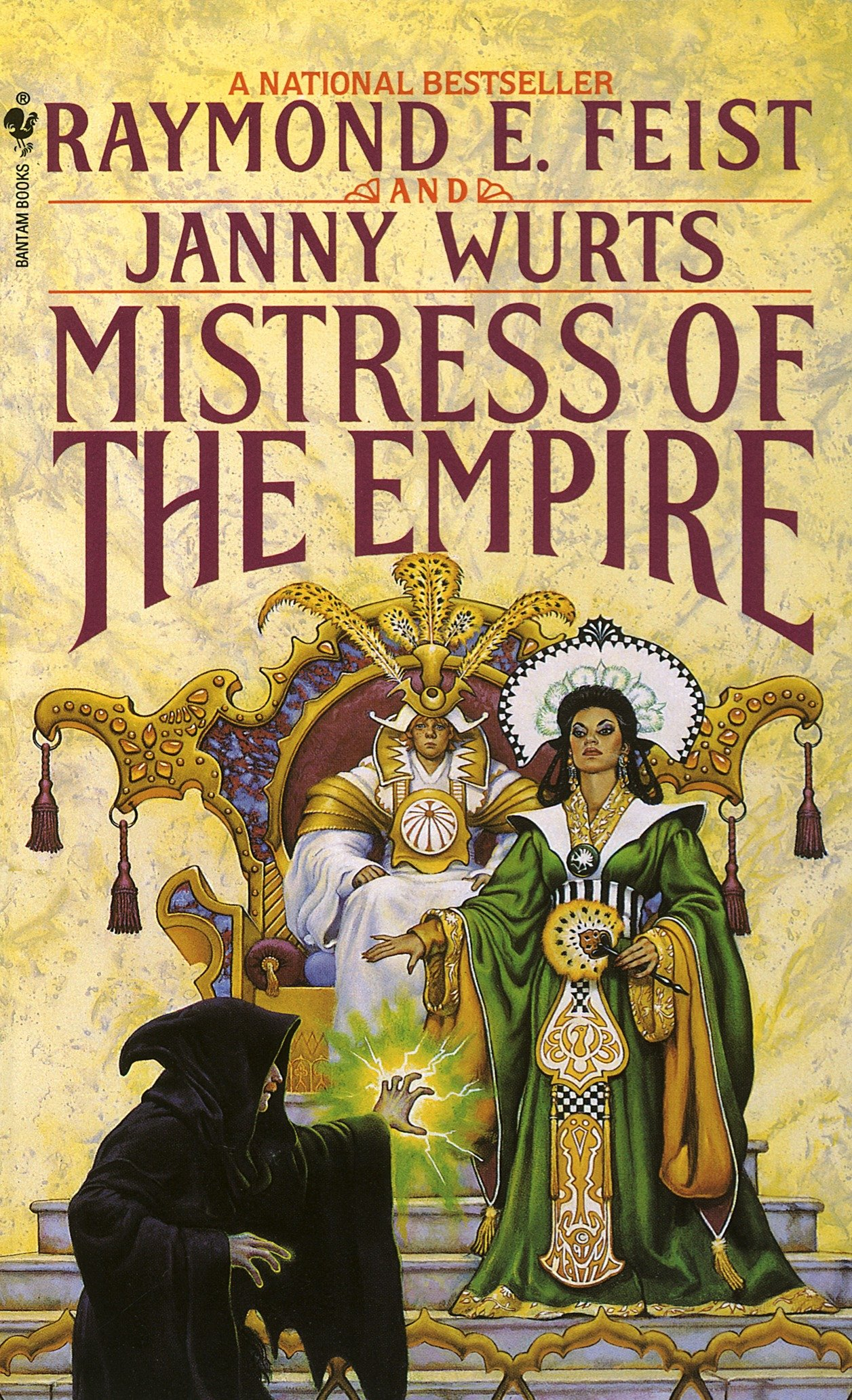
I read this (several months late) as a part of the Library of Allenxandria bookclub. I first learned about this series years ago through a podcast starring Gail Carriger; I read the first book, enjoyed it, but never picked up the rest. Only with the prodding of this bookclub did I get around to finishing it. I think I was put off all that time with how MASSIVE the books are; I listened to the audiobooks, and the final audiobook was 30 hours long.
Spoilers Below. I’m writing this review in good faith, as one author reviewing another’s book, trying to balance positives with negatives.
WHAT IS THE TARGET AUDIENCE? WHAT GENRES? WHAT MAJOR TROPES?
- 14+ years old
- Kickass Lady Protagonist. Mara is a feminine leader of a noble house. She schemes and plots her way to victory. She does not fight herself.
- Political fantasy, Game of Thrones style
MY EMOTIONAL RESPONSE/ FUN FACTOR
I have a love/hate relationship with this series. I love it’s setting, and how honor informs all the characters, from the highest prince to the lowest slave; this texture of honor is utterly unique in the fantasy genre and I adore that. On the other hand, I dislike how everyone’s relationship with honor is the exact same, from the highest prince to the lowest slave. I’ll talk about this below.
I give this 4 stars, which is in the top 35% of books I read.
WARNING! QUIT READING NOW UNTIL YOU FINISH READING THE BOOK!
BIASES STATED
To put this review/study in proper context, you must know my starting point.
I enjoyed political fantasy, especially when it does NOT go super grimdark and angsty about it. This book has politics, and also lacks that self-serious gore-and-despair factor that grimdark books sometimes acquires. AKA, I really enjoyed this.
SIMILAR BOOKS/OTHER BOOKS IN THE SERIES
CONCEPT AND EXECUTION
This series concept is: ‘The sole-surviving heir of a noble dynasty is thrust unexpectedly into power when all of her relatives are assassinated. It’s up to her to survive in a world out to kill her. She has to deal with assassinations, economics, slavery, politics, military matters, and raising children. Throughout it all, she must maintain her honor. She lives in a massively patriarchal culture, and Mara uses that to her advantage by constantly having her enemies underestimate her.’
This book’s plot is EXCELLENTLY well executed. Honestly, this series might have the best execution for any book I’ve ever read. The story beats I listed above (assassinations, slavery, etc) frequently blend into one another: the economics of trading with enemy nations, the politics of freeing slaves, assassins coming for her children, that sort of thing. This is FANTASTIC, it makes the book feel realistically messy. In the real world, events can cascade together into greater crises than they are individually; too often in fantasy books plot points don’t touch one another.
Now for a small quibble from me, these books feel too long. If these books are episodic tv shows, each book is a season with a TON of episodes. It felt like some of the episodes were well-written filler episodes. I would have liked these to be a bit shorter.
CHARACTERS, CHARACTERIZATION AND DIALOG
Mara is a unique bloom in a garden of similar flowers. In a genre filled with girl and women characters whose agency is defined by masculine-coded violence, Mara is feminine. Mara doesn’t pick up a sword, she doesn’t hurt anyone (directly). She is a mother, and she loves her children. She enjoys being a traditional woman, even though she opposes the patriarchy in her own way.
If I were to summarize, this entire genre is filled with authors who haven’t a clue how to write a woman protagonist who a) has agency and b) isn’t violent. Forgive me for being coarse, but open up a ton of books and the women protagonists are men with boobs. Not Mara. And that’s fascinating.
This series explores the medieval patriarchy. Mara chafes at not being taken seriously. Usually this causes problems; people CONSTANTLY think they can take advantage of her, resulting in Mara regularly having to fight off rivals who think they can muscle into her territory. But she’s also clever enough to use this to her advantage; as an example, in book 1 she manipulates one of her two most hated enemies into a marriage alliance by taking advantage of being underestimated due to her femininity. Mara is constantly in a ton of danger from the men surrounding her, but at the same time she learns to use her femininity as a weapon: as a lover, she seduces men into destroying their own finances; as a mother, she secures power by raising children to solidify her dynasty; as a matriarch, she wields power and controls the fate of nations.
And yet, Mara is a deeply flawed person. She was born into a slave-owning society, so naturally she starts the series with the belief that slavery is a-okay. Why bother questioning the status quo, especially when she benefits from it? She’s unaware of evil under her nose. However, in book 2, she falls in love with a slave, Kevin. Over time, as she sees Kevin struggling through entirely understandable suffering from being trapped between love and slaver, Mara begins to realize just how evil this institution truly is. Through this romance, Mara begins to question every aspect of her society- not just the patriarchal aspects but also the human and cho-ja slavery. Mara is a deeply flawed person, but she’s capable of change.
Arranged around Mara are a bunch of supporting characters. There’s Arakasi, the spy; Nakoya the political advisor; Lujan, the bandit-turned-warrior. I could go on, but you get a point. Mara has friends/servants, and she’s well served by all of them. At first, when I only read 1 book, I didn’t think they were very fleshed out characters. However after finishing the series I realize I was wrong. They had texture and nuance all along, I just didn’t see it. They are great characters.
SPOILERS
One aspect I particularly like was how even after characters died, the protagonist would constantly remember and mourn them. The character Papaweo dies at the end of book 1. In book 3 the still-living characters would remember his loyalty and grieve for him, years later. This mourning helped flesh out and build up the characters, adding weight to them long after they’d passed. This happened again and again. By the end of book 3, most of Maras friends had died honorably for her, and it felt deeply emotionally moving.
Now for the bad-ish part. The villains kinda sucked.
There were four antagonistic factions: the Minwinabi, the Anasati, the Tong and the Black Robes.
The Minwinabi were probably the best of these first three. I’d describe them as Harkonen-lite; they were sadists who liked murdering puppies. They were deeply hateable, and acted spitefully against Mara even when they didn’t have to. When book 2 ended with the all killed, it felt good. They were evil for evil’s sake, which is boring, but oh well.
The Anasati were a rival noble family. The authors didn’t do a good job of giving them a vibe, like the authors did with the Minwinabi/Black Robes/Tong. Their only character trait was ‘Against Mara.’ They were underbaked, needed more time in the oven.
The Minwinabi and Anasati both were not very deep; they didn’t have great internality as characters. Mara as a deeply emotionally complex character; having her contrasted with ‘I like killing puppies’ Minanabi and the ‘I didn’t get over being dumped two decades ago’ Anasati was… uninspired. They both felt a bit like sock puppets when compared to Mara’s rich characterization.
The Tong started extremely intimidating, but the authors went back to that well a few too many times. The Tong are an assassination cult, and the primary villains behind all the assassination attempts against Mara. For the first 1.5 books, they were scary. However, partway book 2 there was a massive battle where a TON of Tong assassins attacked the palace and were killed. After that, they stopped being scary. Because Kevin could singlehandedly kill so many of them, they stopped being intimidating. In book 3, I broadly liked how they were handled, but this faction never recovered the intimidation factor after that book 2 battle.
The Black Robes were the best defined: they were an Assembly of Magicians who are above the law in all respects. They see it as their appointed purpose to maintain the balance of power in the Empire. As an example, in book 1 when Mara was weak and nearly killed by the Minwinabi, the Black Robes helped her defeat the Minwinabi, resetting the balance of power. In book 3, Mara has become EXTREMELY politically powerful, so now the Black Robes are intent on killing her to reset the balance of power.
I liked the texture of this faction; as a democratic institution of mages, every decision is made by a quorum. Officially, the Black Robes aren’t supposed to pick sides in the Game of the Council, but in practice anything but. The mages would bicker and quarrel with one another. Some mages liked Mara and agreed their society was stagnant and needed to change and secretly helped her. Others liked the status quo and subverted the rules of the Assembly of Magicians to defeat her.
The Black Robes are above the law, and want to maintain their power at all costs; Mara, in her goal to make the Empire more equal, is their enemy. The Black Robes nearly find victory, but are forced to admit defeat by Mara politically out-maneuvering them. In this context, the conflict against the Black Robes is a microcosm of the story of the series as a whole: the forces of change rebelling against the forces of stagnation, trying to make the world a better place in the face of people who like things as they are right now.
PACING AND STRUCTURE
Here’s the structural breakdown of book 3, as I remember it. SPOILERS!
- Book 3 begins with Mara’s son being killed by the Tong, and it’s framed on the Anasati.
- Hostilities break out between Mara and the Anasati, but the Black Robes side with the Anasati. Mara is forbidden to fight back against the Anasati, on pain of death. As a result, Mara’s allied houses start being killed one-by-one by the Anasati, and she can’t do anything about it.
- The Tong try to kill Mara again. They fail, and Mara’s nearly killed. Fed up, Mara tasks her spymaster Arakasi to defeat the Tong. In the process, we learn the Tong were hired by a combination of the now-dead Minanabi and the still-alive Anasati.
- Arakasi defeats the Tong. While doing his mission, Arakasi falls in love. His love does not return his affection.
- Arakasi investigates the Black Robes, and a method to get around them forbidding war. He’s nearly killed, but is saved by his love.
- Mara asks the cho-ja what’s up with the Black Robes. They send her overseas.
- Mara travels to Fantasy Scotland, and is taken captive. We explore the patriarchy there. At first, Mara’s very afraid she’ll be enslaved. Instead, we learn that the women there have significant power. The ladies there help Mara.
- Mara goes to the homeland of the cho-ja. She’s nearly killed again. Instead, she gets their help in the rebellion. She returns home.
- She returns home just in time for the Anasati to kick off a rebellion. The Emperor is dead; now Mara MUST take the throne for herself before the Anasati does. If she loses, her family dies.
- A series of schemes follows, with the Anasati and Mara trying to out-scheme one another. Anasati are defeated by Mara’s husband using cavalry (a modern invention) compared to Anasati relying on stagnant techniques of battle.
- The Black Robes don’t want Mara to put her son on the throne; that would concentrate too much power in her person. They will do ANYTHING to defeat her. Mara must now take the throne with several dozen virtually omnipotent mages out to kill her.
- Mara is forced to send her allies, friends and family to their deaths as bait to distract the Black Robes long enough for her to sneak into the capitol city and save her son.
- With the help of the cho-ja and her political allies in the churches, Mara puts her son on the throne. The Black Robes are forced to submit.
- Epilogue! Kevin comes back. Everyone’s happy. The end.
Looking at this, it flows together natural from storybeat to storybeat. It’s a season of television, where each bullet point marks a single episode. This episodic mode of storytelling works well. It has several major arcs:
- The fallout of her son’s death,
- Investigating the Tong, and defeating them
- Investigating the black robes in the Empire,
- Travelling abroad to investigate the black robes
- The civil war, and defeating the Black Robes.
These individual major arcs work well. However, I thought this book was too long. I feel like at least one of these major arcs could have been trimmed down some. The ‘investigating the black robes’ arc was neat, but it wound up being a bit fluff. Maybe the ‘investigating the Tong’ and the ‘investigating the black robes in the empire’ arcs could have been fused together to save time.
PLOT, STAKES AND TENSION
This has good plotting. I’ve explained early, so need to restate.
I enjoyed the stakes. Part of the problem I had with the first book in the series was how without stakes it felt. If an author wants to write good stakes, it’s important for the protagonist to have something on the line, for defeat to be possible. The protagonist began book 1 so low (her family were already dead, her estates were already in collapse), it was hard to go lower; stakes therefore felt relatively low.
But Mara’s so good at her job, she rallied in book 1 and got rich and gained power. THIS IS GOOD. Her being rich and powerful in books 2 & 3 increased the stakes. She gained friends and family in book 1; her friends and family started dying in book 2 & 3. In other words, the authors wrote checks in book 1, and cashed them in books 2 & 3. No point in an author giving the protagonist friends if you aren’t going to kill a few of them to raise the stakes. This is good trilogy writing.
Too many series are too kind to their protagonists, and are unwilling to REALLY put them through the wringer. I loved this trilogy; the Game of the Council has consequences, and like a good chess match you have to be willing to sacrifice a few pawns to take the king.
That said, this book didn’t feel very tense, despite the fact that so many of the protagonists friends/allies were slain. I don’t know why, I can’t put my finger on why. Usually raising the stakes (which this series did well) would increase tension, but I didn’t feel that raising of the tension here for me. Oh well, not a big deal. I was invested in the plot anyway.
One problem with the plot I need to point out; this book’s timeline feels like it’s tied intricately with that of the timeline of the main Riftwar books. I’ve not read those books. Events in this series feels like a LOT of important stuff is going on off-screen. As an example, between the end of book 2 and the beginning of book 3, peace with Midkemia was declared and the Empire and Midkemia started trading together. When did that happen?! Why did that happen?! They were at war in book 2!
AUTHORIAL VOICE (TONE, PROSE AND THEME)
I think this series had a beautiful writing style, focusing on lush details like the flavors of food and the texture of cloth. It describes small details well, like what small bottles used for carrying poison looks like. This adds depth and character to a setting, and helps adds to the realism.
The series tone was serious, but not grimdark. Heroes die regularly, but it’s not played for cheap shock value, or drawn out with unnecessary drama, or flippantly forgotten shortly thereafter. This series looks the darkness in the eye and addresses it.
Overall, I liked this book’s political vibe. The Game of the Council is the rules of engagement for the various noble families of the Empire; blood feuds, trading pacts, assassinations, alliances and economics are bound up in honorable protocol. More on this in a moment, but there’s one aspect of this politicing I didn’t like.
The book ends with the heroes putting a crown on Mara’s son’s head. Everything magically gets better after that, apparently, because the series doesn’t address the clean-up period after the subjugation of the Black Robes and the defeat of the Anasati.
Now that she’s in charge, Mara is trying to institute reforms on the stagnant Empire political system, and abolish the Game of the Council. In other words, no more blood feuds, in favor of a system of actual laws. IRL, you just know there’d be lots of dissent against her. It’s not really brought up. The Game of the Council has been around for centuries; I have a hard time imagining that people would give it up so easily.
SETTING, WORLDBUILDING AND ORIGINALITY
Okay, I’ll just start with the big one. This series setting is SUPER honor based, to the point of absurdity. I got vague Asian/Shogun vibes from it. I’ll wave around the ‘Orientalism’ flag very briefly. I’m not an expert on the topic, so I’ll just leave it there.
Moving on, I like this series’ honor-based society. Honor is the glue that keeps the Empire glued together; everyone plays by the rules, because that’s honor is protocol like how ‘be reasonably polite to people’ is the daily rule for us in the real world. It’s very unique in the fantasy genre, for how weird everyone acts; EXTREMELY important people willingly commit sepuku at several points in order to repair a breach in protocol. The Game of the Council plays into this fascinatingly, where open war is inevitably declared over being snubbed at parties.
I do have a problem: people all relate to honor in the same way, from the highest prince, to lowest slave. This is a caste based system, and it’s near impossible to rise in the ranks, so you’d expect that people lower on the totem pole will treat honor differently. Here are some examples of what I’d have liked done differently.
- I’d have liked this book to feature more social mobility than it did.
- At the end of the series, Lujan is freed from Mara’s service and he’s allowed to start his own noble house. Lujan started as a brigand.
- This is extreme social mobility in a society where social mobility is repressed-that’s a fascinating idea, and it went unexplored.
- I would have liked Lujan start his noble house early in book 3, so we can see the social consequences of this extremely rare occurrance. How do other nobles treat him? How does he start treating people who are part of a lower social caste than him.
- I wanted people at different ranks to treat honor differently.
- As an example, maybe really powerful families disvalue the honor of politeness, because they have intergenerational honor. Thus the rich and powerful value rudeness because rudeness is a status symbol.
- Another example, a slave really values the honor of politeness, because they have no intergenerational honor. Thus this slave is polite, and he is a leader among slaves because he is honorably respectful.
- Maybe priests value the honor of piety, and are willing to help slaves because the slaves are pious and defy nobles because the nobles are impious
- The Women of the Reedlife value the honor of not being violent to women. Have pimps and madams hire the tong to execute bad johns, and everyone say, ‘What did you expect? Act with dishonor and you get what you have coming.”
- Perhaps the Assembly of Magicians, being a democratic institution, is a meritocracy and values hard work and achievement as honorable, as opposed to the hereditary aristocracy of the rest of the Empire. Let there be culture clash between the meritocratic magicians and the aristocracy.
That’s what I wanted. This book used honor as the social glue for everything, but took only a surface look at it. NOW THAT SAID, this series did that somewhat by including Kevin and having his outsider’s perspective on what is and is not honorable. As an example, in the Empire it is honorable for a slave to serve, while on Kevin’s planet it is honorable to escape slavery. I wanted more of that.
In short, this setting feels like it was designed from the top-down. So much of this book’s perspective on the Empire is seen from a top-down perspective, from Mara’s level and the level of equally powerful aristocrats. What does culture look like if you’re a peasant, or slave? Surely they don’t have the same cultural mores as the rich and powerful.
AUDIOBOOK NOTES
The audiobooks are good.
LESSONS LEARNED
As an author, I want to improve my own writing/editing skills. To that end, I like to learn lessons from every story I read. Here’s what I learned from this story:
- Be careful to not just top-down worldbuild
- The honor-based culture this book is from is REALLY COOL… but it doesn’t feel organic. Real cultures and societal expectations change depending on the social strata people occupy.
- ‘Honor’ is the main theme of this society. How is a priest honorable? How is that honor different from a king’s honor? How is it different from a slave’s honor? Explore your theme from multiple angles.
- After exploring the theme from multiple angles, how is the theme in tension with itself? Real cultures are often hypocrical, when looked at from a certain angle. That hypocritical messiness adds that bit of real life, organically grown detail to really make a setting sing.
- Don’t betray your characters by making them act uncharacteristically.
- Mara of the Acoma is a feminine character. She doesn’t get her hands dirty herself; she pays people to do that for her.
- It would have been too easy for the authors of this book to betray the foundational idea of this character and make her skilled in combat herself. I’m REALLY glad they never did that, because Mara is awesome precisely because she stays true to type throughout.
- Write feminine characters
- Write deeply emotional characters, with earnestly held friendships and loved family members
- Set up, and pay off throughout a series
- One thing this series does well is writing checks and cashing them.
- In book 1 and 2, this series introduced a lot of interesting characters. In books 2 and 3, this series killed a lot of them. This series is memorable because it was wiling to go there, kill many important characters, and not handle it in a gauche way. Too many fantasy books lack this social grace and commitment.
Here’s a link to all the lessons I’ve previously learned.
SUMMARY
Did you like this critique/review? Here are some more: The Rest of My In Depth Reviews
On a personal note, I’m open to editing books. I don’t like putting myself out here like this, but I’ve been told I should. Check my blog for details if interested.

 John Mendez- Book Reviews and More