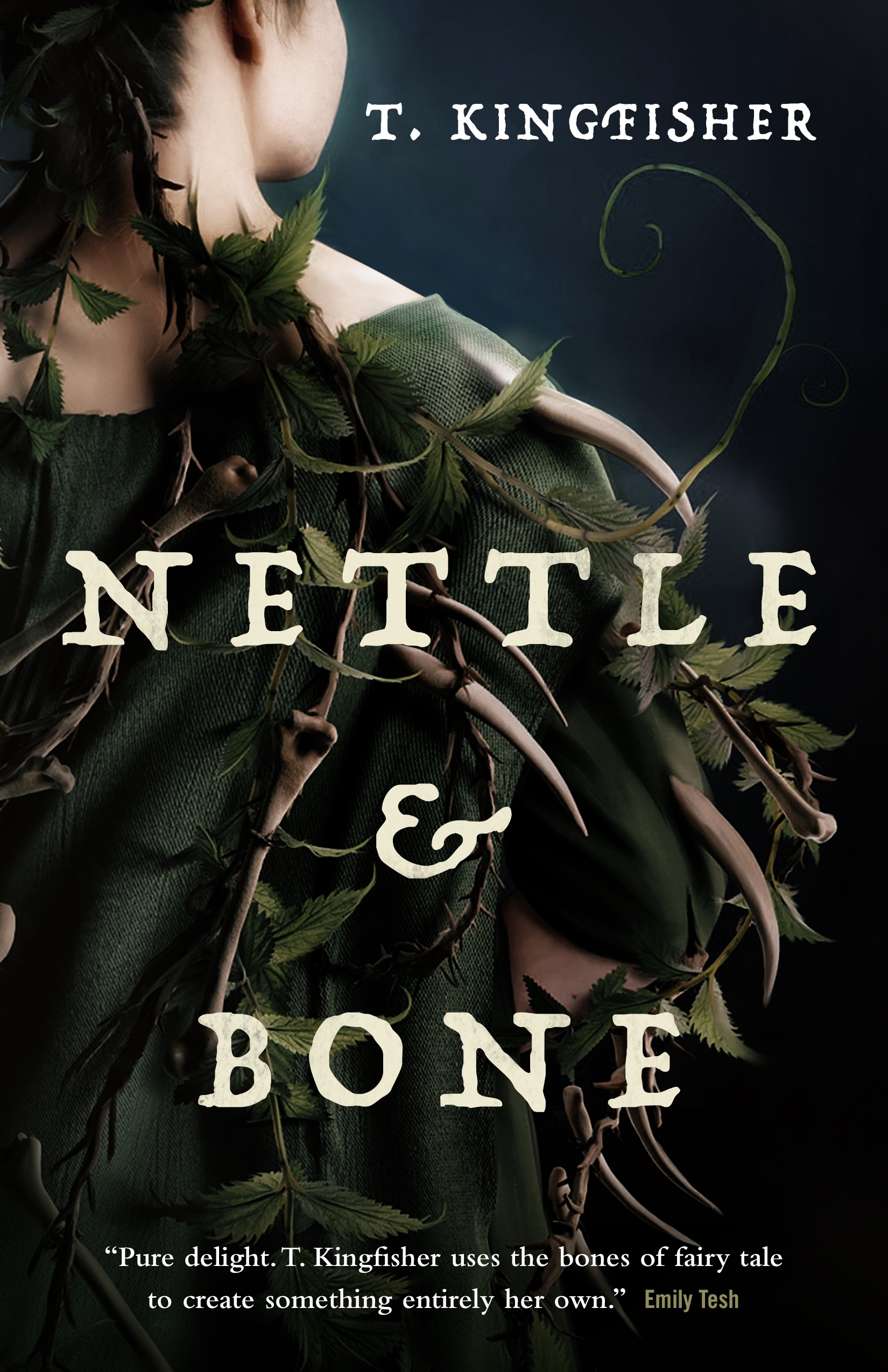
Spoilers Below. I’m writing this review in good faith, as one author reviewing another’s book, trying to balance positives with negatives.
What a charming book! This is the second Kingfisher book I’ve tried to read, after ‘Paladin’s Grace.’ I DNFed ‘Grace,’ not because it was bad but because it was too romance forward for my personal taste.
I recently read Jo Walton’s Hugo retrospective book, and ‘Nettle and Bone’ won the Hugo. I saw ‘Nettle and Bone’ on Kindle Unlimited, and I impulse downloaded it.
NOTE: This book discusses pregnancy, child death, spousal abuse and other pregnancy related issues. I’m going to touch on that here. Tap out now if you’re not interested.
WHAT IS THE TARGET AUDIENCE? WHAT GENRES? WHAT MAJOR TROPES?
- Short book
- Grimdark Fairy Tale aesthetic
- Fairy Tale Feminism
- Twee and Whimsy
- Middle-Aged protagonist
- Nun protagonist
- (Arguably) a neurodivergent protagonist
MY EMOTIONAL RESPONSE/ FUN FACTOR
Gotta admit, this made me happy. I like the magic/mystical aesthetic this book had. It felt adorably twee, contrasting with it’s darker elements. Despite it’s sentimentality, the book avoided mawkishness (aka sickly sweet). It reminded me of McKillip’s ethereal settings, and I love McKillip.
WARNING! QUIT READING NOW UNTIL YOU FINISH READING THE BOOK!
BIASES STATED
To put this review/study in proper context, you must know my starting point.
I entered this after reading and disliking a BUNCH of other Hugo-nominated books. I was in a bad mood as a result and decided in advance I would dislike this book. My first reaction to reading this book’s first chapter was, “Oh no, I like this book.” This book convinced me to change my mind and like it.
SIMILAR BOOKS/OTHER BOOKS IN THE SERIES
- The faerie tale feminist bits of this reminded me most of Uprooted by Naomi Novik
- The grimdark faerie tale magic reminded me of a slightly more hardcore McKillip.
CONCEPT AND EXECUTION
This book’s concept is: ‘A fantasy princess is banished to a nunnery after one of her sisters marries a foreign prince. Our nun-princess learns that her sister is trapped in a abusive, loveless marriage, where the prince-turned-king treats his wife as a broodmare to produce an heir. Our nun-princess then goes on an adventure to save her sister, and her kingdom, from the deprivations of this madman. Grimdark fairy tale schenanigans ensue.’ This is a good concept.
As I mentioned in my ‘Hugo’ section above, the author was firing on all cylinders. The prose, plot, characterization etc. was all average to above average. This is a well executed story. If I were to point to some particular stand-outs, I liked characterization and the texture of the worldbuilding/prose of the worldbuilding.
I like being a devil’s advocate and say ‘no book is perfect, here is this book’s fatal flaw.’ I can’t think of anything major here. (I have minor quibbles, but nothing major.) This book is good.
CHARACTERS, CHARACTERIZATION AND DIALOG
I really like Marra. She seemed coded neurodivergent in some way, maybe autistic or something like that. She probably has some sort of anxiety condition.
She had an arts-and-crafts personality. Instead of looking at people, she’d look at tapestries on the wall and think to herself, “I wonder if I can make that?” She’s not a witch herself, but she’s so crafty she uses her innate skill with arts-and-crafts to create undead dogs and invisibility cloaks.
In a recent review, I complained about a book lacking sincerity. Marra’s arts-and-crafts personality is the sort of sincerity I like. Marra’s not good in social situations, but she thrives in a weird niche. I interpret her as an autistic person with a special interest, and she’s not ashamed of her special interest. Instead of being a fan of anime or stamps, Mara’s special interest is weaving, which a minor in midwifery and creating taxidermy statues of dead dogs from their bones.
IRL, neurodivergent people are punished for sharing our special interests with other people; being so sincerely passionate about something random is considered cringey. Instead, Marra embraces her weaving and threadwork special interest and thrives. Marra must deal with people who don’t understand her; the other nuns think she should enjoy the glamor and glory of the life of the aristocracy. But Marra is different. She’d rather muck out the stables than wear dresses and go to parties. Good for her, doing what makes her happy.
All of the other characters are good. Bonedog is a good boy. Fenris was a good love interest, even though he didn’t get much character development. Agnes was low-key the best character in the book; she reminded me of Magrat Garlick from Discworld, being in over her head but also surprisingly powerful. And finally, the dust-witch had great Granny Weatherwax energy I just love.
One thing I didn’t like was Prince Vorling, the antagonist. He was EXTREMELY out of focus of the story. He was more of a shadow off the scene, with very little dialogue or actions. We see and hear his impact (the spousal abuse and murder) but he’s given little agency to the plot. I think Vorling should have been tied deeper into the plot; perhaps he could somehow be responsible for the evil of the blistered lands, so defeating him will get rid of the cannibals via magic. As is, he’s just kinda a prop who needs to be knocked over. He needed more agency to truly be intimidating.
PACING AND STRUCTURE
I love reading Epic Fantasy, but I just hate how the genre is bloated with 1000 page books. Not here; this classic fantasy tale clocks in at a brisk 250 pages.
This book is broken up into the following arcs:
- In the Nunnery/Convent, and introducing the main plot
- The death of a child, and travelling to meat the dust-wife
- Weaving an impossible cloak, and creating a dog from bones
- The goblin market, and freeing a knight from the fae
- Agnes, the vaguely useless godmother, and meeting the Scary Eldritch Evil Godmother (Also budding romance goes on in the background)
- Through the tombs
- The Climax
Overall, I feel like this was oddly structured. The first act, and the third act felt like they came from one book. The middle act felt like it was in an entirely different genre. Weird structure.
PLOT, STAKES AND TENSION
This was a political fantasy novel, about a nation cursed by an evil Godmother. The royal dynasty and the Godmother made a deal: the dynasty gets to rule that kingdom for as long as the royals allow the godmother to suck the life out of the kings and queens. The dynasty and kingdom lives forever, at the expense of short-lived rulers. The problem then becomes having children in time before you die young. Thus enters the main plot.
The present king needs a wife and an heir desperately. Marra’s sister marries the present king, and is horribly abused, forced to go through repeated miscarriages and pregnancies, slowly killing her. Marra offers to use her nun apothecary skills to brew birth control for her sister, but her sister refuses. When queen Kania’s not pregnant, the king is physically abuse with her, so the queen feels she must remain pregnant as much as possible to avoid physical abuse. However, the king killed one of his previous wives; if Kania does bare an heir, the king might kill her afterwards.
In short, this a catch-22 situation. If the queen refuses to bear the king’s children, she’ll be abused and killed; if the queen does have the king’s children, she might be killed afterwards by the psychopathic king. And slowly, the queen is dying, the cost of being continually pregnant. This is a classic lose-lose situation, and the only way out is for Vorling to die.
Marra feels compelled to free her sister from this doom. Not knowing what else to do, she seeks out a witch of dubious morality, called the dust-wife, and together they go on an adventure, saving a knight from the fae, building a dog from bones and recruiting a vaguely useless faerie godmother.
Finally, about the final climax. Basically, from the moment the heroes arrive in evil king’s town to the end of the book, everything went perfectly. Usually in heist novels- and the end of this book was basically a heist- something goes wrong at some point and the heroes have to improvise. That didn’t happen here. This made the final act of the book feel stress-free. It needed more stress.
I enjoyed this book’s tension. It’s clear Marra doesn’t really like her sister, but she feels filial loyalty and will do anything to save her. The queen’s inevitable doom is on the horizon, either by the psycho king lashing out and killing her in a moment of pique, or the queen just being drained by pregnancy.
I didn’t like this book’s stakes. Show don’t tell; we’re TOLD that if the Harbor Kingdom doesn’t marry into psycho king’s family that the Harbor Kingdom will fall. We’re never SHOWN the stakes, we’re not SHOWN invading armies, or ransacked lands. This particular aspect of the book, (the cold war between the Northern Kingdom and the Southern Kingdom, with the Harbor Kingdom between them) felt underbaked, included merely as a formality to explain why Kania and Vorling were forced to get married.
Finally, I have to say that the middle half of this book and beginning and the end felt like different books. The middle (when Marra goes to get the dustwife/Fenris/Agnes/Bonedog) had STRONG faerie tale vibes. The beginning and end felt like Game of Thrones. Overall a pleasant read, but weirdly like two books stitched together.
AUTHORIAL VOICE (TONE, PROSE AND THEME)
This book set out to discuss spousal abuse and the cost of pregnancies.
At first, Marra doesn’t really understand her sister is suffering. Marra sees from a distance that her sister keeps getting pregnant, but she never understands why they don’t come to term. Only after becoming a nun midwife and working with mothers and babies, does Marra finally put together the pieces. You can visibly see Marra finally gaining the understanding that her sister is in danger from undergoing so many pregnancies and miscarriages in succession. This, coupled with discovering bruises on her sister, makes Marra realize her sister is being abused.
This arc was good, but not quite perfect. Now that I’m looking back on the story from a distance, I think it would have been better if Marra acted as midwife for her sister’s final pregnancy. Marra did very little in the ‘final battle’ of the story; having her be midwife would have given her a key role to play. Maybe have the heroes help the queen escape Vorling, and when they’re on the run Marra helps when the baby comes early. After that, the story can play out pretty much the same as before.
I dunno, that’s my 2cents. I’m not a woman, or a doctor, I don’t know enough to have an informed opinion on this topic.
This book felt weird. On one hand, it had twee fairy tale vibes. On the other hand, insane cannibals and spousal abuse. It was dark, but also twee. Somehow it all worked when glued together, but it wasn’t a clean. This book was a bit of a tone rodeo.
SETTING, WORLDBUILDING AND ORIGINALITY
I loved this worldbuilding. I liked the through-the-mirror-darkly spin this had on normal fairy tale stories, with wicked godmothers, family curses, buried undead tombs, and the like. I loved how Agnes and the Evil Godmother sat down and had teatime together, just gossiping. This setting is so down to earth, yet so eerie.
I loved how the protagonist created Bonedog by wiring together dog bones, and the dog spontaneously comes to life. I loved how the protagonist wove her own cloak. What I did NOT like was how the final plot never did anything with the cloak or Bonedog. The cloak was sort of a cloak of invisibility, and they didn’t use it in the final adventure. Bonedog was just cute comic relief, but not really plot vital for defeating Vorling. If you’re going to make three Chekovs Guns (in the form of Marra’s three impossible tasks), fire them. This book fired the bottled moonlight, but not Bonedog or the cloak.
I liked and didn’t like the curse-child. The characters meet an innkeeper who is haunted by off-brand Pinocchio. This marionette was a child’s favorite toy becoming so invested with a child’s love that it becomes alive. The trouble is it only stays alive so long as the child continues loving it, so Pinocchio becomes violent with the child (now an adult innkeeper) to keep her enslaved. Super creepy, might be the best worldbuilding in the book. Can you imagine one of your childhood invisible friends coming to life and haunting you as an adult as an evil spirit? *Shudder*
The heroes offer to destroy the marionette, but the innkeeper refuses, in a moment resonant with spousal abuse, where the abused won’t leave their abuser.
I liked this creepy marionette… HOWEVER I thought it was foreshadowing that at the end when the queen would be similarly entranced to Vorling in an abusive marriage. That didn’t happen. As is, I appreciate what the author was doing here; introducing the reader to the idea that the abused won’t leave the abuser.
And finally, the blistered lands. They reminded me of The Wood from Uprooted and the evil lands from Blackwing. I liked this in concept, but the book never did anything with it. The book touched on cannibals in fairly deep detail in the beginning, but nothing about the end of the book was about cannibals or had resonance with cannibals. I dunno, I feel like the author could have done some ‘Fisher King’ stuff with the constantly dying royalty and the ever-expanding blistered lands. Seems like low-hanging fruit in retrospect.
I like parsimonious worldbuilding. This book didn’t need cannibals as well as dustwives, fae, fairy godmothers, undead dudes, and whatever the f the Toothdancer was. Trim out the cannibals, and instead use fae at that point.
LESSONS LEARNED
As an author, I want to improve my own writing/editing skills. To that end, I like to learn lessons from every story I read. Here’s what I learned from this story:
- Have a cute dog
- Arts and crafts protagonist.
- Have a sensible protagonist who contrasts with the really weird world all around them. I loved how Marra was challenged with impossible challenges, and instead of giving up, she just got to work, put in the effort, and used her knowledge gained in the convent. She succeeded because she’s more practical than sensible.
- Discuss uncomfortable topics. This book discusses pregnancy, miscarriage and spousal abuse quite bluntly. This is good, because spreading information is good.
- Fire your checkov’s guns
- A Checkov’s Gun, or a ‘gun on the mantle’ is in reference to the idea that ‘if you introduce a gun in the first act of your story, you should fire it in the third act.’
- This book had three Checkov’s Guns, in the form of the Bonedog, the nettle cloak, and a bottle of moonlight. This book never made use of the Bonedog or the nettle cloak.
Here’s a link to all the lessons I’ve previously learned.
SUMMARY
The author is clearly in the full flower of her talent, and has crafted a good, if flawed, story. I will read more of her stuff in the future.
This book won the Hugo. I… I don’t feel like it’s a particularly excellent book. It’s not on the tier of ‘Dune’ or ‘Jonathan Strange and Mister Norrell,’ two other Hugo winning novels. But it is good, and I do think most people would enjoy it. I’d happily read N&B again. It reminds me of mid-tier Pratchett. I give it 4 to 4.5 stars, which I only give to the top 30% of books I read.
Did you like this critique/review? Here are some more: The Rest of My In Depth Reviews
On a personal note, I’m open to editing books. I don’t like putting myself out here like this, but I’ve been told I should. Check my blog for details if interested.

 John Mendez- Book Reviews and More