Spoilers Below. I’m writing this review in good faith, as one author reviewing another’s book, trying to balance positives with negatives.
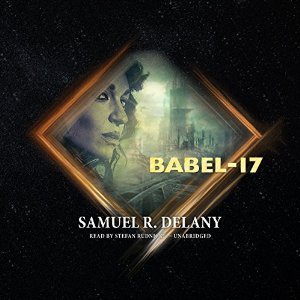
This book is a classic of the genre. I heard about it through Jo Walton’s ‘An Informal History of the Hugos.’ This book lived up to the hype, even though I didn’t love it.
This book’s worldbuilding is wild: there are people who get body modifications like sabertooth teeth, extra dragon heads and the like; succubi; ghosts who can interact with spacetime in such a way as to enable interstellar travel. Seemingly on every page, a new idea is revealed.
SPOILERES FROM HERE ON
The biggest idea this book fiddles with is a language so perfect it can control people. This book is a member of the genre of ‘big ideas’ sci fi, discussing language in various ways. ‘Babel-17’ is the name of an language invented to be used as a weapon in an interstellar war between two galaxies.
The language you think in controls how you view the universe. For example, if you read ‘Ancillary Justice,’ the main trick in the book is that there is only the female pronouns. There are still men in this setting, but they also use female pronouns. As a result, when you read ‘Ancillary Justice’ you have difficulty guessing what we would call the ‘gender’ of a particular character is. Because the language of gender in the ‘Ancillary’ setting is different, characterization and sexuality is different.
In ‘Babel-17,’ the language of Babel-17 has no pronoun for ‘I.’ The language possesses no vocabulary for ‘self-actualization,’ so learning the language is enough to subjugate your soul to the language. Babel-17 is an infectious brainworm meme which contaminates people, forcing them to become rebels and fight in the intergalactic war. This is a fascinating idea to base a book around.
WHAT IS THE TARGET AUDIENCE? WHAT GENRES? WHAT MAJOR TROPES?
- People 15+. It’s targeted to adults, but 15+ can read it.
- High-Concept scifi
- Worldbuilding
- Space opera
- Political vibes
MY EMOTIONAL RESPONSE/ FUN FACTOR
I liked, but didn’t love this book. In terms of sheer quality, I can see why it became a classic. It deserves the title. But it’s not my vibe entirely. This book is old, it was published in 1966, and you can see the rust on this book. While it was extremely progressive for it’s time (sympathetic woman main character, sympathetic view towards poly side characters), by modern standards it’s a bit outdated (the tech used in this setting includes tapes to record sound, and this uses telepathy as a plot point, something out of fashion in modern scifi).
I think it’s definitely worth reading, but go in expecting a small amount of rust.
WARNING! QUIT READING NOW UNTIL YOU FINISH READING THE BOOK!
BIASES STATED
To put this review/study in proper context, you must know my starting point.
I generally think that older scifi/fantasy have worse plotting and pacing than modern scifi/fantasy. I came into this skeptical.
THAT SAID, I am generally of the opinion that older scifi/fantasy books are better written prose-and-voice wise than modern books. I came into this hopeful. Net total, mixed bag.
CONCEPT AND EXECUTION
This book’s concept is ‘Telepathic linguist is given the task of translating a mysterious signal originating from enemy space, which seems to somehow be associated with various sabotage attempts. She discovers it’s a constructed language created by the enemy to transmit coded instructions to sleeper cells, instructing them on how to sabotage and assassinate people. But the more of it she learns, the more strange events happens around her… Until she realizes that she’s learned too much of the language and it has mind-controlled her. She is now a sleeper-cell herself, destroying her own nation from within. She must go to war with herself, trying to escape the language before it’s too late.’ This concept is cool.
I felt this concept was middling executed upon; not bad, not good. There is so much potential in this concept, which the book didn’t realize. The reveal that the language is an infectious mind control agent is only realized in the final 20% of the book; by that time, the book is winding down. The book is only 187pages long, so there’s really not enough space in that final 20% to really breathe life into this concept.
CHARACTERS, CHARACTERIZATION AND DIALOG
By the standards of 1966, this book is extremely progressive. The protagonist is an independent woman, but not of the modern and toxic “‘not like other girls’ girl” trope. Rydra Wong is just a normal woman but in a harsh situation, and manages to thrive because she’s brilliant.
It’s not forced brilliance, either. At one point, her ship is stranded out in space and they don’t know where they are. She manages to calculate their position based upon the rotational axis of a set of marbles in 0gravity; a brilliant idea I’d never have thought of.
By the standards of 2023, this book felt leering toward Rydra. This book had mixed perspectives; mostly from Rydra, but occasionally from the men who surround her. When in the perspective of the men, they often objectify her. It’s kept fairly low-key and in the subtext, but the subtext is loud and clear.
The story felt a little fat-phobic at moments, calling one woman ‘porcine.’ The book called other women ‘succubus,’ and I’m not 100% confident that that refers to some sort of science-created sex creature and not a normal sex-worker.
All of this put together is nothing extreme, even by modern standards. It’s probably only on 5 pages or so, and it’s mostly mild, and hidden in the subtext. If you want to ignore it, it’s easy to ignore.
So, yeah. There’s some rust on this book. It’s nearly 60 years old. I think this is worth reading. If you look at a lot of other progressive scifi classics, they’ll be similarly rusty: I’d point to the homophobia in Ursula LeGuin’s ‘The Left Hand of Darkness.’ ‘The Left Hand of Darkness’ is still worth reading, and so is ‘Babel-17.’
PACING AND STRUCTURE
This book is short, at under 200 pages. I LOVE how short it is, modern books are too long. (I say that even as I’m writing a looong book right now, lol.) This short length is a good, and bad thing.
It’s good because the book doesn’t overstay it’s welcome. It tells it’s story, and finishes.
It’s bad, because this book was so short it never sold me on it’s underlying vibe. This book was trying for a ‘Manchurian Candidate’ vibe, where learning a language is an infectious agent of revolution. By the time it started telling that story, the book was 80% already over.
The book was short, I was left feeling hungry for more when it was done. Being a little hungry for more is good; being a LOT hungry is not good. This book left me a LOT hungry once it was done.
PLOT, STAKES AND TENSION
The plot was good. A lot of older scifi/fantasy books don’t have great plot, in my experience. This book’s plot had better plot than most of that era. By modern standards, this book’s plot holds up. It’s not amazing by modern standards; the mouthfeel of the story didn’t feel very crunchy or spicy. But the plot objectively holds up.
The book’s stakes and tension never felt fully realized. Show, don’t tell. The enemy galaxy was never fleshed out. Why would it be terrible if they won the war? It was never explained.
AUTHORIAL VOICE (TONE, PROSE AND THEME)
Ah, man, I love when I read older classics. I don’t know why, but they usually have better prose. Something about older books sing to me. ‘Babel-17’ is no exception to this rule.
Thematically, this book explored the intersection of culture language. It discussed how biology and culture change how we use language. For example, there is an alien species in this book whose physiology is all about heat. Their language explores the nuance in heat deeply. It was really neat. This book had polyglot characters, speaking everything from Swahili to English to Babel-17.
But, going back to how short this book was, I felt it could have gone deeper. It was too short to do that, though.
SETTING, WORLDBUILDING AND ORIGINALITY
A lot of modern fantasy/scifi books are padded with a bunch of fluff which wouldn’t be tolerated in the past/in other genres. This book felt like it needed more padding.
Rydra Wong was a fleshed out character, but a bunch of the side characters felt shallow. Indeed, when looking at this book from above it feels broad and vast as an ocean, but when you zoom in that ocean is an inch deep. Why are there ghosts? It’s never explained. What’s up with the war between galaxies? It’s never explained. Is Rydra the only telepath, or are there others? It’s never explained.
A lot of aspects of this book’s worldbuilding go unexplained. The book didn’t need to answer these questions. But by including these bits of worldbuilding and not expounding on them, the story felt like a grab-bag of whatever the author had on hand, and not a cohesive story and setting. If you compare this to something like Sanderson, Sanderson re-uses the same piece of worldbuilding again and again, to fully show what makes it special.
In my experience, many old books which we regard as classics feel a bit hollow. When you compare the world of this book to the Cosmere by Sanderson, the worldbuilding in ‘Babel-17’ is neat but undeveloped. It feels like Delany threw a small amount of lot of spices into the stew, to create a flavorful melange. Someone like Sanderson adds a lot of one spice (one spice=one magic system), to create a strongly flavored stew with a single flavor. Delany’s book feels vast, but not deep. Sanderson’s feels deep, but not broad.
Simply put, we in the modern day have different standards. I’m NOT saying that old books are bad; I’m saying we judge books based on different guidelines today than yesterday.
Finally, the tech in this book didn’t really hold up. I noticed that the characters used ‘tapes’ to record sound. I just read a review which pointed out the use of the saying ‘it was black as a coal chute.’ As a result, this book feels like retrofuturism. For some readers, that’s a plus; for others, it won’t work. It didn’t really work for me, but I forgave it.
AUDIOBOOK NOTES
The audiobook was good… with one quibble. The protagonist was telepathic, and occasionally evasdropped on people’s memories. When the audiobook did that, there was a haunting sound effect. If you dislike voice modulation in your audiobooks, avoid this. It wasn’t extreme, though.
LESSONS LEARNED
As an author, I want to improve my own writing/editing skills. To that end, I like to learn lessons from every story I read. Here’s what I learned from this story:
- Short books are good, but be sure to include enough padding to make the setting and story really sing.
- We judge older books differently from newer ones. This book feels older.
Here’s a link to all the lessons I’ve previously learned.
SUMMARY
This was a very well told story, and deserves it’s rating as a classic. It won’t be for everyone, but if you’re curious about the genre give it a go.
Did you like this critique/review? Here are some more: The Rest of My In Depth Reviews
On a personal note, I’m open to editing books. I don’t like putting myself out here like this, but I’ve been told I should. Check my blog for details if interested.

 John Mendez- Book Reviews and More