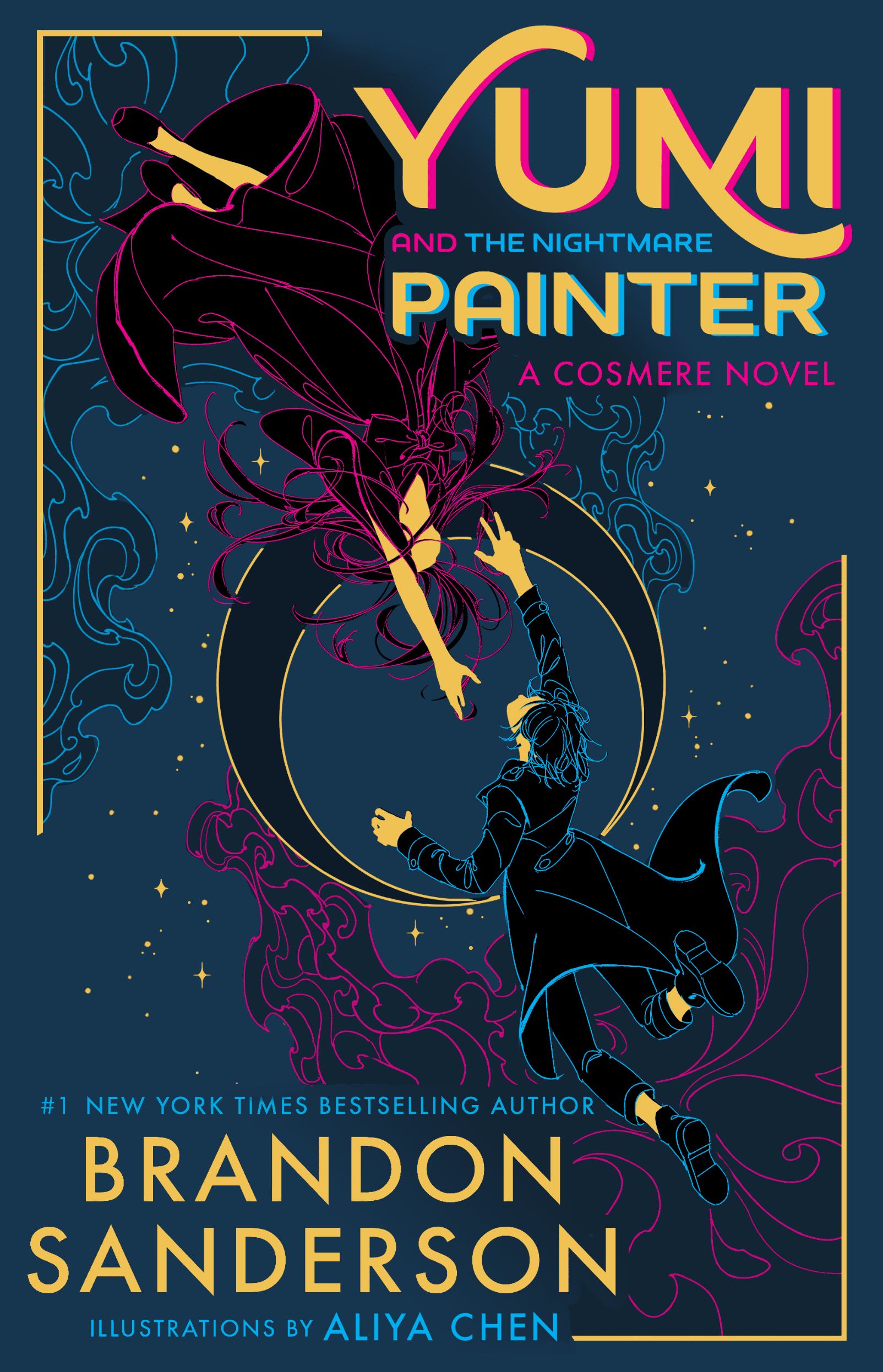
Spoilers Below. Starting on a positive note, I think this is the second best Sanderson book I’ve ever read. While this is certainly a flawed book, I have to admit this book had me in tears at moments. My complements to the author and artist, this book was lovely.
WHAT IS THE TARGET AUDIENCE? WHAT GENRES? WHAT MAJOR TROPES?
- Cosmere fans, but not exclusively. While I think non fans can read and enjoy this, this book is at it’s best for fans.
- Cyberpunk
- 15+. It contains a chaste romance. No sex.
- Neat worldbuilding. The author introduces two cool worlds: a world of eternal day, and a world of eternal night. Helpful, Miyazaki style spirits occupy the day, while evil nightmares haunt the night.
- Anime and K-Drama. This world is high-tech, and multiple characters are a fan of the various K-Dramas/soap operas which occupy the airwaves.
- Japanese and Korean inspiration.
MY EMOTIONAL RESPONSE/ FUN FACTOR
I loved this at moments. I give this 5 stars. For reference, I give 5 stars to only 15% of books I read, so this is in the upper crust of what I read.
I almost wanted to put this in the top 10 books I’ve ever read, but ultimately couldn’t. Why? Read on.
WARNING! QUIT READING NOW UNTIL YOU FINISH READING THE BOOK!
BIASES STATED
To put this review/study in proper context, you must know my starting point.
I like sanderson books, but don’t love them. I haven’t read all the cosmere novels. I gave up on the Stormlight Archive because I just wasn’t feeling it.
CONCEPT AND EXECUTION
This book is a ‘Freaky Friday’ book. Yumi is a anime-inspired shrine maiden, who communes with the spirits to aid her people. After a weird magical accident, Yumi ends up body-swapping with Painter, who lives on another planet in the cosmere. Painter inhabits Yumi’s body, and he’s forced to learn the refined arts of being a Shinto priestess who stacks rocks to please the spirits, while Yumi must replace Painter, painting nightmares to prevent them killing people. They must pretend to be one another, while trying to figure out how to end this curse.
The twist is that while Yumi inhabits Painter’s body, Painter’s soul haunts Yumi, and while Painter inhabits Yumi’s body, Yumi haunts Painter. Hilarity ensues as Painter (a shlub of a modern dude) breaks infinite social taboos of Yumi’s Medieval Japanese social structure, while Yumi struggles to gain confidence in a fish-out-of-water setting.
The book is executed fairly well, but could have been better.
This book could have been 30 to 50 pages shorter. I have this problem with a lot of Sanderson’s books.
The book’s main plot (aka the mission about why both protagonists are body swapping) was basically not begun until 60% of the way into the book. This made the book feel very slow, until all of the sudden A LOT started happening and the pacing picked up.
The book is written around a twist at about 80% point. I liked the twist. However it needed more foreshadowing. More on this later.
CHARACTERS, CHARACTERIZATION AND DIALOG
Yumi is an emotionally suppressed individual. As a shrine maiden, she was raised from birth to be separated from everyone else, coddled like a child even as an adult. She can’t dress herself, bathe herself, or even feed herself. Her mother figure is passive aggressive to the point of emotional abusiveness. It is very easily to sympathize with Yumi. She desperately needs to learn how to stand up for herself in the face of confining social taboos.
Painter is emotionally suppressed in another way. We discover that he’s been rendered a social pariah after a mistake he made in the distant past. He’s a VERY talented artist, but he’s so depressed after being made pariah that he’s lost his creative muse.
He needs Yumi to help him learn to trust again, and Yumi needs him to learn how to break social taboos. The pair of them had a great dynamic. Both are artists, and they bond over their very different artforms.
This book wasn’t a romance, until all of the sudden it was at the very end. I felt this slow build worked.
I enjoyed the side characters. Painter’s gang of former friends were fun, from Akane the leader, Izzy the horoscopologist, to Tojin the bodybuilder. The odd side characters like goth alien Masaka to Design the Cryptospren were both delights. In particular, design’s dialogue was hilarious. I especially loved when they just got to hang out together in the noodle shop together, just chatting. It made them feel charismatic, like real people. I wish more books had ‘noodle shop’ chapters like this.
I even liked Liyun, the abusive mother figure. It’s clear she loved Yumi and wanted the best for her. However between Liyun’s traditionalist beliefs and the influence of the nightmare, Liyun was as trapped as everyone else. Ultimately it was Liyun’s loyalty which proved key in saving the day.
THAT SAID, I wish Sanderson did a bit more to help in Liyun’s redemption. I would have liked if Liyun helped in the final battle to save Kilahito city.
PACING AND STRUCTURE
Now for the not-so-good. I felt that this book was slow paced for the first 60%, then suddenly fast paced for the final 40%. The book’s first turning point was when a)Yumi finally worked up the courage to go nightmare hunting, and b)the introduction of the machine. Before these main plot points were introduced, the story focused around introducing the characters and showing how both were fish out of water.
By having Yumi being a fish-out-of-water in Kilahito (Painter’s city), it leads to the revelation that she’s ALSO a fish out of water in Torio (her own city) because she’s been socially isolated by her abusive mother figure. She can only learn to stand up for herself in Torio, if she learns how to do it in Kilahito first. Vice versa is true for Painter.
On one hand, I see what the author was trying to do. You can only show a character is a fish out of water by having multiple instances of them screwing up and behaving in odd ways. That’s show-don’t-tell. The first 60% contained a lot of Painter being a doofus, and Yumi being meek. I felt it dragged the story down, there was so much of it. It was needed, but I feel it could have been reduced some. The greater plot developments in the second half, about the machine, could have been introduced sooner to help even out the plot.
PLOT, STAKES AND TENSION
I enjoyed the plot in the abstract. However, the more I think about the plot net total, I begin to see flaws. The introduction of the idea of ‘a machine which reaps souls’ should have been introduced earlier. The idea that the nightmares are really the souls of the unquiet dead should have been hinted at much earlier.
As it stands, the book has a huge twist near the end. Yumi’s world isn’t real; it’s an endlessly repeating dream sequence, a nightmare sustained by the same nightmares which haunt Painter’s world. The nightmares keep Yumi imprisoned by taking advantage of her meekness and respect for authority. Her character arc of learning to question authority was vital to her piercing the illusion. If she learns to question the gaslighting of her mother figure, she’ll question the gaslighting of her illusion world. This is a legitimately awesome integration of character arc and worldbuilding.
However, in the end I didn’t like the payoff.
I LIKED Yumi’s world, with it’s eternal daylight and flying trees. Having Yumi’s world being fake felt like the author saying, “You were silly to have liked it, it was fake all along.” This would have been resolved if the author did a bit more legwork at the end, by bringing back the flying trees after the shroud was removed.
Similarly, the reveal that Yumi’s world and Painter’s world were the same one felt forced. I think the narrative could have provided more narrative links earlier on, like flying plants in Painter’s world and the occasional nightmare in Yumi’s world.
AUTHORIAL VOICE (TONE, PROSE AND THEME)
Brandon Sanderson’s prose has leveled up a little. This book had a slightly more lush feel. I enjoyed it. It wasn’t much, and it wasn’t evenly spread throughout the story, however net-total I thought it was enjoyable and hope he keeps this authorial style from now on.
THAT SAID, this book was narrated by Hoid. Honestly, I think Hoid wasn’t needed. Hoid added a bit of distance to the text. Narrator Hoid made this a COSMERE BOOK about two people slowly falling in love, as opposed to a book about two young people falling in love which also just so happens to be a Cosmere book. I think it would have been stronger if Hoid wasn’t the narrator, or if Design was the narrator.
SETTING, WORLDBUILDING AND ORIGINALITY
This setting was cool. I liked the initial worldbuilding idea of two worlds: one eternally day and one night. In the day, plants fly to absorb water from the clouds and escape the superheated ground. In the night, light is provided by magical neon lines which paint the sky and power every household object. One world is deeply medieval, and the other cyberpunk. Culture clash, and ecology clash, ensues when the characters meet one another. The final reveal that they are the same world, but separated by two thousand years was a great twist.
I liked the concept behind the nightmares: they are the souls of the dead, harvested by the machine which created the neon lines to power the lines. The nightmares are then freed by the machine to go drink the souls of the living, to sustain the lines. This is a cyberpunk staple, about the dangerous excesses of technology and how society is inured to the banal depravity civilization is built upon. The revelation that ‘The machine is lord’ was chilling and memorable.
I liked the painters and art in this story. The painters were rebel street punks, largely disrespected by society but are nonetheless needed to keep the corporations/the evil government from taking over. The painters fight off the nightmares by painting them, fighting the forces of mindless destruction and oblivion with the act of creation and love.
But it’s not perfect. Above, I mentioned how the street punk artists fight corporations/fascist government in this. That’s a bit of a fib on my part. This book needed an evil corporation or two to really lean into the cyberpunk. (Here’s my headcanon: I think the scholars who created the nightmare machine in Yumi’s world should have been corporate bureaucrats. Two thousand years later, that same corporation now runs Painter’s city, having made a deal with the nightmare machine to feed it’s people to sustain the magic lines, dooming the world to the shroud for the sake of profit.)
I’m not sure Sanderson intended to write a Cyberpunk story, but he made a good one.
LESSONS LEARNED
As an author, I want to improve my own writing/editing skills. To that end, I like to learn lessons from every story I read. Here’s what I learned from this story:
- I really liked the little moments the characters spent together in this, when the cyberpunk street artists were hanging out together in the noodle shop, chatting.
- It made them feel like real people. I’ll miss that noodle shop, because it was a context which let the character repeatedly bounce off one another (aka exposition and character development) in low-pressure environment. More books could use this narrative mechanism.
- The noodle shop risked being boring, due to it being low-pressure. However because Design lived there, and Design is funny, I always looked forward to the noodle shop because they were Design chapters.
Here’s a link to all the lessons I’ve previously learned.
SUMMARY
I heartily enjoyed this, and can strongly recommend this.
Did you like this critique/review? Here are some more: The Rest of My In Depth Reviews
On a personal note, I’m open to editing books. I don’t like putting myself out here like this, but I’ve been told I should. Check my blog for details if interested.


