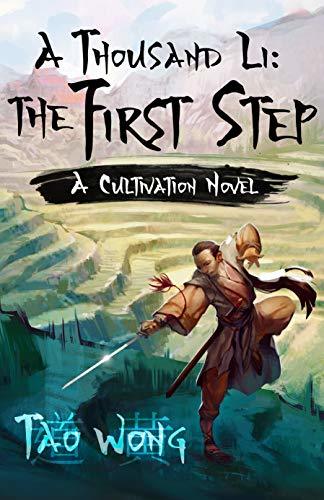
‘A Thousand Li’ is a 12 book long Progression Fantasy series, in the Xianxia subgenre. Even if you have never read any Xianxia, chances are you’ve seen a movie or played a game inspired by it; for example, ‘Crouching Tiger, Hidden Dragon’ and ‘Black Myth: Wukong’ play in a similar area to this genre. It features tropes like meditating sages on mountaintops, alchemical pills made from ancient herbs, wandering swordsmen travelling between the Warring States Period nations of China. If you’ve heard of or read ‘Cradle,’ that is a westernized version of xianxia.
I think ‘A Thousand Li’ is among the best-written series of Progression Fantasy which I have thus-far read. The prose is of a consistent average quality, with the occasional moment of above-average quality… and as this genre has it’s core in the semi-literate fever swamps of Royal Road, this consistent quality is actually quite the accomplishment (and I say this as a fan of Royal Road).
Let’s get started.
SUMMARY
This series is the tale of Long Wu Ying, in his adventure from farmboy to Immortal Sage. It follows the classic Daoist tropes of the genre’s classic magic system (Nascent Soul, Core Formation, et al…); if you have no idea what any of that means, I’ll just say that this series would serve as a good introduction to the genre. The series also plays with the classic political structures of the genre: there are magical sects, warring kingdoms, tournaments, auctions and the like. Wu Ying goes on many, many adventures around the Middle Kingdom and beyond, growing stronger, and doing good deeds wherever he travels.
I heartily enjoyed this series. I’ve only read around ~10 progression fantasy series so far so I’m not very well read in the genre, but for my taste, ‘A Thousand Li’ is so far my favorite. I really enjoy the texture and flavor of the worldbuilding and setting. It actually feels Chinese, in a way which something like ‘Cradle’ feels more Panda Express. (I heartily enjoyed Cradle too, but it’s Asian-inspired elements felt surface-level in retrospect, now that I have the real thing to compare it to.) This series also reminded me STRONGLY of my second-favorite book of all time ‘The Bridge of Birds,’ in terms of setting and and the feel of adventure, but without the humor or silliness.
The tone of this series is a fantasy Chinese pulp adventure novel. I think it was originally published on Royal Road or a similar site, so it’s endless length and many micro-adventures are due the needs to constantly be publishing on a weekly basis. The series was then divided into twelve novels and published on Kindle Unlimited. Most of the novels feature an overarching story main plot… however some of the novels were just glued-together travelogues of many, many micro-adventures which were loosely stitched together without a strong main plot. These travelogue novels were not bad per se; the final book in the series, ‘The Fourth Wall’ was one such travelogue, and was one of my favorites in the series. However, I think on average the novels in this series with stronger main plotlines were my favorites.
Overall, I’d give this series a 4.5 out of 5 stars, where I default to giving good books/series 3 stars. The main ‘flaw’ with the series is the distance between what I as the reader feel and the emotionality of the characters. Speaking of which…
CHARACTERS
Long Wu Ying starts the series as an ambitious son of a rice farmer, who is forcefully recruited to join the military and fight in the war between the Shen and Wei kingdoms of China. His intellect and competence in battle gets him noticed by a passing Master cultivator from the Shen Kingdom’s main magical sect, resulting in Wu Ying joining that sect. Through hard work, discipline, and contribution points he climbs his way up the social ladder within the Verdant Green Waters Sect, starting as a lowly kitchen drudge and making it all the way up to Nascent Soul swordsman and peer to the gods.
Wu Ying is very much so a cypher for the reader. He doesn’t have a strong, distinct personality which sets him apart from other protagonists. For example, Lindon from ‘Cradle’ has the odd social tic of constantly apologizing for everything. Or Kaladin from ‘Stormlight Archive’ battling with depression. Wu Ying is clever, determined, hardworking and lucky… but these are all necessary traits to be a protagonist in the Progression Fantasy genre. Wu Ying feels very much so like an empty set of pants for the reader to put on, and then live vicariously through. Wu Ying is very well done wish-fulfillment power fantasy.
He makes friends (and enemies) with people who have stronger, more memorable personalities. There’s Tou He, Wu Ying’s Buddhist Monk best friend, who tries to be pacifist even as he struggles to adhere to the Buddha’s teachings. I enjoyed the romance between Wu Ying and Yang Mu, Wu Ying’s (late series) love interest. Yang Mu is a roving merchant, while Wu Ying is a wandering swordsman; sometimes they wander together, while at other times they roam China separately. This gave the pair of them the occasional feeling like two ships passing one another in the night, which was a neat dynamic in a relationship I’ve never read before. Wu Ying has genuine-feeling romances, not harems, which begin and end realistically. Wu Ying also had a Draco Malfoy-like Young Master (whose name presently escapes me) to bounce off of throughout the series, who I quite enjoyed for his entirely justified jealousy.
Overall, though, I have to say there is an emotional distance between the reader and the characters. In modern western books, it’s traditional to try to make the reader feel empathy for the characters; for example, partners are said to have ‘chemistry’ together, or two friends are said to be in a ‘bromance.’ Some authors will give characters verbal tics or neurotic urges, to make them more distinct. That sort of depth and texture was not present in these characters, with only one or two exceptions. I’m not going to dock points for it, though, because a)it didn’t detract from my enjoyment of the novels and b)this ‘neurotic’ characterization is very much so a western thing and this series is very much eastern, so trying to glue my expectations upon this series would be inappropriate.
PLOT
This is a progression fantasy series. The main plot of the series is not defeating a dark lord (Epic Fantasy) or graduating from Hogwarts(Young Adult). The main plot of the series is the protagonist going from being a rice farmer to literally becoming a god and getting an invite from the Jade Emperor himself in Heaven for a meet-and-greet (Progression). There were multiple, multi-book spanning plots along the way, but they were the frosting on the cake. Tasty frosting, but ultimately frosting.
With that in mind, let’s talk about the progression.
It was fun! I enjoyed how Wu Ying was constantly advancing in multiple ways, be it learning to improve his swordplay, or taking medicinal baths to cure his wounds, or travelling far and wide to gather alchemical reagents or new chi techniques speed up his cultivation. I think giving the protagonist multiple skill paths to improve upon was an intelligent decision, because it enabled the author to have multiple avenues of progression besides raw magical power.
Now for the frosting.
Throughout the series, Wu Ying and the Verdant Green Waters sect fought against a nefarious (and unnamed) dark sect. Where the Verdant Green Waters used orthodox magical techniques like meditation, the dark sect performed human sacrifice and demonic pacts to gain power. Wu Ying and friends go on a series of adventures over multiple novels, in each one performing a vital quest, ultimately leading to the defeat of the dark sect and burning their palace to the ground around mid-way through the series.
…only this didn’t defeat evil permanently, because this is a twelve book series and we have six more books to go. So Wu Ying and Tou He are called south to deal with a random demonic infestation in either Thailand or Vietnam. And they’re then drawn north to fight against the Cai warlord who’s made pacts with demons.
I liked the concept of what was going on here, but I think it could have been stronger. Instead of having the ultimate war against the dark sect culminate halfway through the series, I would have preferred the final battle to take place in the final novel. While I agree with the author’s decision to add a mid-series climax to shake up the series… the second half of the series felt somewhat listless in comparison to the first half of the series. I feel like the author could have done a better job tying the demons in the south and the Cai warlord back into the dark sect, perhaps in having the Cai warlord being the secret patriarch of the sect all along or something. I dunno, the series is fun, I just would have liked if we looped the end of the series back in with the beginning of the series.
Anyway, after the dark sect plotline ended halfway through the series, our hero was temporarily exiled from Shen because he accidentally offended the King of Shen in the process. Thus started our travelogue section of the series. And low-key I enjoyed these novels. The random adventures were fun to read, even if it never really felt like they were going anywhere. They added a sense of breadth and depth to the world.
Overall, I had a cromulent time with this series. I devoured the first ten books in around two months, waited a couple months, then finished the last few books in a week. I can’t say these weren’t page-turners.
WORLDBUILDING
This isn’t my first xianxia, but everything I’ve read in this genre before now has been by western authors and are thus probably not super authentic. This series featured everything from acupuncture to jade boxes, to five elements (including wood and metal). I could go on, but you get the point. I found it lovely.
I especially enjoyed the philosophizing. The ‘magic system’ of the series is explicitly daoist, and as such has a definitive spiritual element. For example, leveling up requires introspection and meditation on enlightenment; failing to find that insight will result in failure to grow stronger, or even death.
CONCLUSION
Over the last few years, I’ve struggled to find books I’ve enjoyed reading from the traditionally published industry. To be frank, I don’t think the industry has been doing a good job catering novels to boys or men. Which is why this is such a pleasant surprise. I know this series was originally self-published, but finding out that it has been picked up by trad is good news.
I struggle reading some series more than once, mainly because I know the plot so there’s no point in reading it again. I can see myself coming back to read this series again just to exist in the series’ vibe. I’m at a point in my life where I’m enjoying the nostalgic flavor of innocent, fun adventure novels. If you’re like me and in the mood for a twelve-book series, give it a go. Also, I’ve already downloaded the following book. I’ll let you know how I enjoy it.


